Passing on history (Singer Featherweight)

Mum's Singer featherweight 006

In October 2009 my dad gave me my mother’s old Singer Featherweight Sewing Machine, shown above. That meant a great deal to me. I remember this little machine from when I was a wee little girl and my mother was teaching me to sew on it, very carefully. Somehow it seemed larger then, and I think that I was trying to make clothes for my baby doll, but I don’t recall having much success at that young age. Mum sewed clothes for herself, my younger sister and me on that little Singer – dresses and skirts and blouses, mostly, and she did a fine job of it.

Since Mum saved everything, in its sturdy carrying case I found the machine’s original Singer Warranty dated “Sep 11 1957”, stating that the Machine style is 221-1-270 and the number is AG878454. Also of interest, the “conditional sales contract” for her purchase is there, $124.50 – and describes her installment payments. All her receipts are there, too, but there are only three because, true to form, Mum paid her debt early. There is a letter to thank her for her patronage and informing her that she was entitled to a refund which they were enclosing in a cheque. Doing a little research I learned this model is a collectible item of value, and that Mum’s little Featherweight is worth in the vicinity of $350 now.

I still haven’t used this machine (since many years ago) because it should be thoroughly cleaned first just to be on the safe side, but I tested it and it runs so quietly! In fact, it has a contented hum in comparison to my larger and heavier portable Kenmore which I bought for myself in 1976, and on which I made clothes for my daughters and myself.

Do you have anything you cherish that has been passed on to you?

Thanks for reading, and … Creative Musings! 🙂
NaBloPoMo: leaves in transition

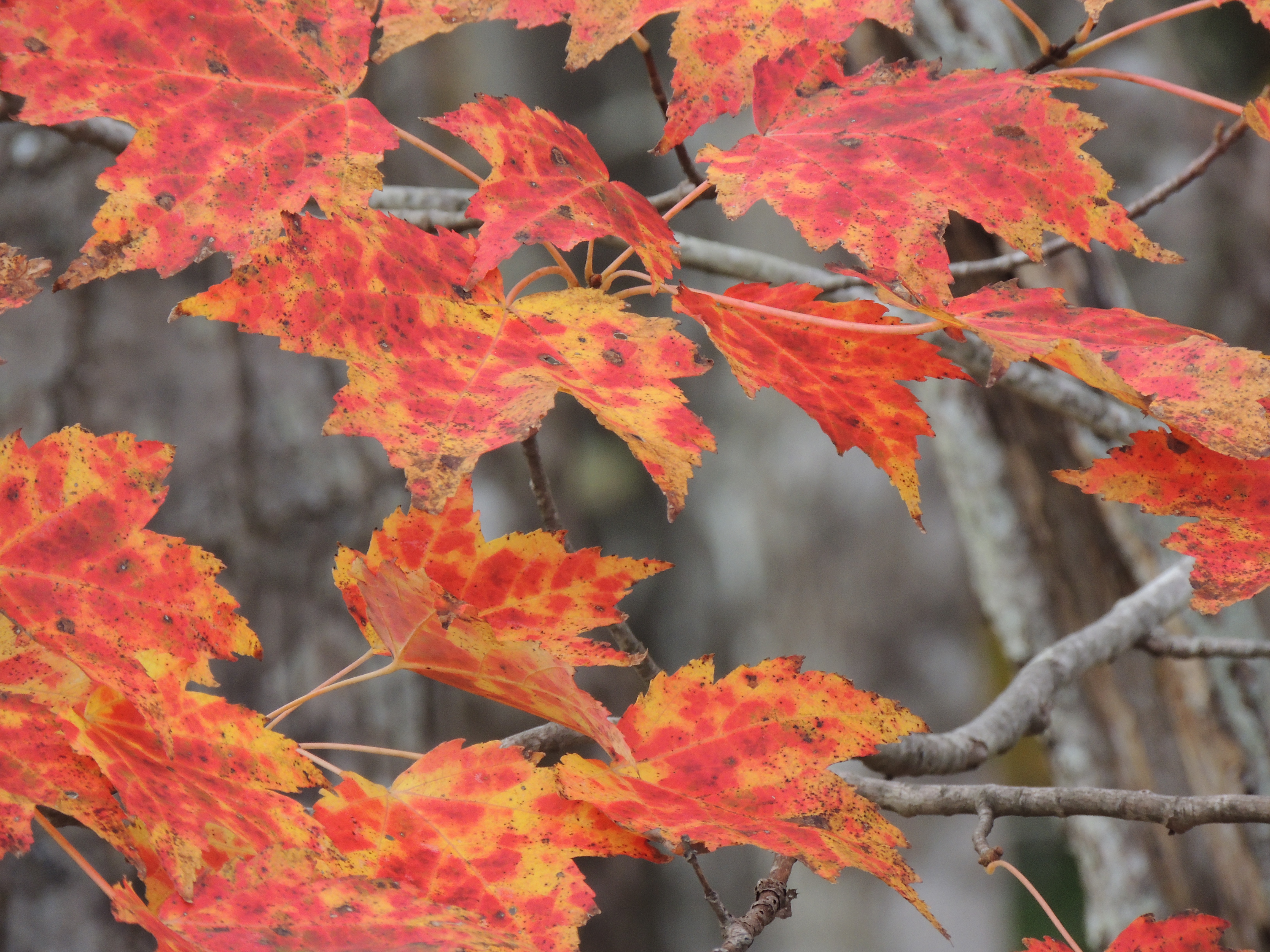
dscn1093.jpgIt has been a very busy day but I want to post something for NaBloPoMo before the day is over. I thought you may find the coloration of these maple leaves interesting.

We had a very windy Friday and Saturday, but mild with some rain. So many of our Autumn leaves have been beaten off the trees making a colourful carpet on the ground.

Fall is not my favourite season because of the cooler weather it brings in leading into Winter cold, but it is such a beautiful season. This year it seems to be an especially exquisite one here in Nova Scotia.

What is your favourite season and why?

Thanks for reading, and … Creative Musings!


NaBloPoMo – I am participating for the first time!

NaBloPoMo?  what is that?

NaBloPoMo_November_badges_small

National Blog Posting Month. It was started in November 2006 as a counterpart to NaNoWriMo. Each day in the month of November bloggers post something new on their blog. (They actually keep going for the whole year if wanted, but it seems November is a busier month because of NaNoWriMo.) It can be as simple as a photo or a quote, or as lengthy as they want to take the time to write.

Do I have enough to do this month? One would think so, but here I am adding another challenge to my already quite full list. I decided since I will likely be posting here every day, anyway, keeping updates of my NaNoWriMo progress, I could attempt to add a little to each post for this challenge, too.  So, crazy or over-extended — or both! — here I am. By the time my blog appeared on the long list this morning, it is number 1258 with over two hundred after it!

To console those who don’t like tons of posts from me, I seriously doubt I will continue every day after this challenge ends. And I will try to make it interesting for the next 28 days.

If you love to blog and would enjoy this challenge, go here for information, then sign in and sign up! Or simply cheer me on.  🙂  That would be great, too.

Are you doing this challenge, have you ever, or would you like to another month? How often do you usually blog?

Thanks for reading, and … Creative Musings!  🙂

I’m participating in NaNoWriMo and PiBoIdMo 2013!

November is again a busy writing month for me. I signed up for National Novel Writing Month for my fourth year, and Picture Book Idea Month for my third year – having passed on it in 2012. I am going to make an honest attempt to do both again even though my life situation (caregiving) has not changed.

3886950-fountain-pen-writing-paper-with-black-inkAfter midnight last night a thought came into my mind, then an idea was taking shape, then the thought became the title, and before I went to bed I had a rough ‘rough draft’ of a story for a picture book. Day one accomplished for PiBoIdMo!

Not so for NaNoWriMo, I regret to say, as I have not written a word there yet. I am still writing the novel I began in NaNo 2010, since I’ve worked on it only during the last three Novembers. My word count is a combined total of 123,900 – give or take a few words. When I stopped near midnight of November 30’12 it was at a place one would call a “cliffhanger”, and was a bit exasperating to my sister who read it all after NaNo had ended last year. 😉  She was not happy with where I stopped and told me emphatically I had to finish the story! Even I am not sure what is going to happen next, but my characters will gradually let me know when I get into it again … which should have been today, but that’s not happening!

If you are asking, ” What is she talking about?!” I will briefly explain.

NaNoWriMo – or National Novel Writing Month – is the worldwide challenge to write a novel (really a novella) of 50,000 words in 30 days. You have to start with a fresh idea to ‘win’, but there are many who are NaNo Rebels, which is perfectly fine, too. I won (reached the goal of 50k) the first year but the next two years I participated as a Rebel in order to add to the novel I had begun and want to finish. This year I am doing the same.

If you are interested in checking out NaNoWriMo, click here. If you are taking part in it this year, let me know if you want a buddy.

PiBoIdMo – or Picture Book Idea Month – is the brainchild of Tara Lazar which she started in 2009. It is quickly becoming the widely known challenge to write a picture book idea a day during the 30 days of November. It’s for those writers who don’t want to take on creating a novel but would enjoy participating in a book writing challenge. Some of us do both. 🙂 Each day you write something … anything … a title, the name of a character, an idea for a story, or even a whole draft if it works out for you, so at the end you should have at least 30 ideas for picture books! Cool, huh? I think so! Oh, and there are super guest posts, lots of writing genius shared, and even prizes! I love that I end up with so many ideas for PB’s, even if I ‘win’ nothing. It is sort of like a conference but with so much added.

If you are interested in signing up for – or checking out – PiBoIdMo, click here. Registration closes SOON, so hurry!

Now I must create a new page for my NaNo updates so if you want to keep track of what I am managing to do you can read it there. Click on the NaNoWriMo updates (2013) link at the top of the page. Besides, if you want to cheer me on, Heaven knows I need it! 🙂 It may be crazy for me to be taking this on since I am behind in reading, reviewing, interviewing, but sometimes I need a change of pace to get refreshed and inspired anew. At least, I hope that’s what will happen! 🙂

Are you participating in either of the above challenges?

Thanks for reading, and … Creative Musings!  🙂
‘Read More Books’ Challenge: Week 4: 156-207 of the list of 623 of the best books ever!

Are you ready for week four of our Read More Books challenge? 

Read HERE to learn about it. It’s never too late to join in.

Check the ones you may have missed or want to review:

WEEK ONE   WEEK TWO   WEEK THREE

How did you do with your reading? We had an extra week to read between postings this time. Even if you didn’t finish the book you selected, it counts if you select one for this week to add to your TBR pile.

Here is week four’s list:

156. Ironweed — by William J. Kennedy
157. Persuasion — by Jane Austen
158. The Rainbow — by D. H. Lawrence
159. A Dance to the Music of Time — by Anthony Powell
160. The Unbearable Lightness of Being — by Milan Kundera
161. Kim — by Rudyard Kipling
162. Brighton Rock — by Graham Greene
163. One Flew Over the Cuckoo’s Nest — by Ken Kesey
164. The Adventures of Augie March — by Saul Bellow
165. A Bend in the River — by V. S. Naipaul
166. The Hound of the Baskervilles — by Sir Arthur Conan Doyle
167. Housekeeping — by Marilynne Robinson
168. Sophie’s Choice — by William Styron
169. Ethan Frome — by Edith Wharton
170. Buddenbrooks — by Thomas Mann
171. Thérèse Desqueyroux — by François Mauriac
172. The Killer Angels — by Michael Shaara
173. Anne of Green Gables — by L. M. Montgomery
174. If This Is a Man and The Truce — by Primo Levi
175. The Bridge of San Luis Rey — by Thornton Wilder
176. A Moveable Feast — by Ernest Hemingway
177. Dubliners — by James Joyce
178. Ficciones — by Jorge Luis Borges
179. Schindler’s List — by Thomas Keneally
180. The Prime of Miss Jean Brodie — by Muriel Spark
181. Strange Case of Dr. Jekyll and Mr. Hyde — by Robert Louis Stevenson
182. Far from the Madding Crowd — by Thomas Hardy
183. Gilead — by Marilynne Robinson
184. Nausea — by Jean-Paul Sartre
185. The Wings of the Dove — by Henry James
186. The Little Prince — by Antoine de Saint-Exupéry
187. The Red Badge of Courage — by Stephen Crane
188. The Odyssey — by Homer
189. Memoirs of a Geisha — by Arthur Golden
190. Men Without Women — by Ernest Hemingway
191. The Tale of Genji — by Murasaki Shikibu
192. Cannery Row — by John Steinbeck
193. Life of Pi — by Yann Martel
194. In Our Time — by Ernest Hemingway
195. The Pilgrim’s Progress — by John Bunyan
196. Jude the Obscure — by Thomas Hardy
197. Breakfast of Champions — by Kurt Vonnegut
198. Six Characters in Search of an Author — by Luigi Pirandello
199. The Day of the Locust — by Nathanael West
200. The Stand — by Stephen King
201. Austerlitz — by W. G. Sebald
202. Cat’s Cradle — by Kurt Vonnegut
203. The Public Burning — by Robert Coover
204. Harry Potter and the Goblet of Fire — by J. K. Rowling
205. The Wind-Up Bird Chronicle — by Haruki Murakami
206. Man’s Fate — by Andre Malraux
207. Jazz — by Toni Morrison
 
 
I love to hear from you!  From the above list:
  • Which books have you read?
  • Which books do you want to read?
  • Which books are you going to obtain this week?(Even if you are not officially taking the Read More Books challenge I would love to hear about your reading.)

Note: I got permission to share this list on my blog. (Thank you, Stuart!) You could go HERE for the list of “623 of the best books ever written” and see them all at once for yourself, and/or you can follow the list here a few at a time.

Thanks for reading, and … Creative Musings! 🙂

Sue Harrison’s “Writing the Third Dimension” – part 10: The Writer as Actor

Welcome! Over the next many months we invite you to return here, specifically on the fourth Thursday of each month for the newest installment of Sue Harrison‘s teaching: Writing The Third Dimension. You can read all the segments by clicking on the page title WRITING THE THIRD DIMENSION, found under Writers’ Helps & Workshops on the drop-down menu. Please feel free to ask questions and leave comments for Sue. Now for the topic for month ten:

******

“Writing the Third Dimension” – part 10: The Writer as Actor

In my first three Alaska novels, my characters do not sit on chairs. They don’t even sit cross-legged on the ground; they squat on their haunches. This is a very typical pose for people who live without furniture, but the problem is, other than on a few camping trips, I’ve lived with furniture all my life. So to write about my ancient Aleut people, I had to learn how to sit on my haunches. It wasn’t easy, but, by learning, I avoided having my characters do something that would not work physically.  In effect, I became an actor and acted out the “sitting on haunches” portions of the novel. Since then, when I’m writing a scene, I often get up from my chair and act it out right in my office. It’s amazing how much more convincing and realistic your words will be if you back your scenes with a healthy dose of “acting out.”

Janet_Marie_Chvatal_'Sissi'

Here are a few acting tips that might help you as you write your novel:

1. If you are writing fight scenes and have no experience in that particular arena of life, take a self-defense class. It sure helped me write more realistic and gritty fight scenes.

2. Don’t be afraid to take up a new hobby. If your main character sews quilts, buy a book, take a class, do a little quilting.

3. Use your mirror. Imagine yourself angry and look at your face in the mirror. What are you doing with your eyes? Your mouth? Your eyebrows? Don’t get overly descriptive. A word or two will do.

4. Enlist your DVD player. Watch a good movie and check out how the actors express their emotions. Replay scenes that catch your heart and keep a pad handy to jot down the first words that come to mind as you watch the actors laugh, cry, express anger, fear, dread, etc.

5. Watch babies and young children. They haven’t yet learned to guard their feelings by masking facial expressions. They are the exaggerated versions of adult facial behavior.

6. Read articles or even a book about body language.  My husband, a high school principal, had a training session in how to tell if people are lying. He shared the information with me, and since then it’s appeared in subtle ways in my short stories and my novels.  The Internet abounds with resources. Take an hour or so  and have fun learning how people express emotions with body language.

7. Pay attention to hands and feet. A person might have a good poker face, but his/her hands and fingers, feet and toes are “saying” what s/he really feels.

The next time you sit down to write, remember, you’re not only a writer; you’re an actor. Stride boldly onto the stage and become your characters!

Have fun! Any questions?

Sue

*Writing the Third Dimension, copyright, 2010 Sue Harrison*

Sue HarrisonBestselling author, Sue Harrison, has written two Alaska trilogies: The Ivory Carver Trilogy and The Storyteller Trilogy, and a middle readers’ book SISU. Prior to the publication of her novels, Harrison was employed at Lake Superior State University as a writer and acting director of the Public Relations Department and as an adjunct instructor in creative writing and advanced creative writing. For more information, click here. To inquire about booking Sue for workshops or speaking engagements this year, click here.

Thanks for joining us! Please feel free to leave your questions and comments. We invite you to come back November 28, 2013, for part 11.

‘Read More Books’ challenge: Week 3: 104-155 of the list of 623 best books ever!

Are you ready for week three of our Read More Books challenge?

Read HERE to learn about it. It’s not too late to join in.

Check WEEK ONE and WEEK TWO of the list.

How did you do with your reading? Even if you didn’t finish the book you selected, it counts if you select one for this week to add to your TBR pile.

NOTE: Next Thursday, Part 10 of Sue Harrison’s writers workshop will be the highlight. Come back October 31 for part four of the reading challenge. This gives you more time to read until the next list of books. 🙂

Here is week three’s list:

104. The Heart is A Lonely Hunter — by Carson McCullers
105. Vanity Fair — by William Makepeace Thackeray
106. Commedia — by Dante Alighieri
107. The Count of Monte Cristo — by Alexandre Dumas
108. An American Tragedy — by Theodore Dreiser
109. White Noise — by Don DeLillo
110. The World According to Garp — by John Irving
111. Atonement — by Ian McEwan
112. Nostromo — by Joseph Conrad
113. The House of Mirth — by Edith Wharton
114. The Brothers Karamazov — by Fyodor Dostoevsky
115. The Good Soldier — by Ford Madox Ford
116. The Name of the Rose — by Umberto Eco
117. The Shipping News — by Annie Proulx
118. The Woman in White — by Wilkie Collins
119. Herzog — by Saul Bellow
120. The Counterfeiters — by Andre Gide
121. My Antonia — by Willa Cather
122. Scoop — by Evelyn Waugh
123. A Room with a View — by E. M. Forster
124. Bible: King James Version
125. Wide Sargasso Sea — by Jean Rhys
126. Love in The Time of Cholera — by Gabriel Garcia Marquez
127. The Remains of the day — by Kazuo Ishiguro
128. The Big Sleep — by Raymond Chandler
129. I, Claudius — by Robert Graves
130. Tropic of Cancer — by Henry Miller
131. Tender is the Night — by F. Scott Fitzgerald
132. Journey to the End of the Night — by Louis-Ferdinand Celine
133. The War of the Worlds — by H. G. Wells
134. A Suitable Boy — by Vikram Seth
135. Possession — by A. S. Byatt
136. A Confederacy of Dunces — by John Kennedy Toole
137. The Bell Jar — by Sylvia Plath
138. Waiting for Godot — by Samuel Beckett
139. The Brief Wondrous Life of Oscar Wao — by Junot Diaz
140. Being and Nothingness — by Jean-Paul Sartre
141. A Thousand Acres — by Jane Smiley
142. The Amazing Adventures of Kavalier and Clay — by Michael Chabon
143. The Gulag Archipelago, 1918-1956: An Experiment in Literary Investigation — by Aleksandr Solzhenitsyn
144. Charlie and the Chocolate Factory — by Roald Dahl
145. Lady Chatterley’s Lover — by D. H. Lawrence
146. JR — by William Gaddis
147. The Histories — by Herodotus
148. Doctor Zhivago — by Boris Pasternak
149. Lucky Jim — by Kingsley Amis
150. Underworld — by Don DeLillo
151. If on a Winter’s Night a Traveler — by Italo Calvino
152. Life — by Georges Perec
153. The Master and Margarita — by Mikhail Bulgakov
154. The Good Earth — by Pearl S. Buck
155. Henderson the Rain King — by Saul Bellow
 
From the above list:
  • Which books have you read?
  • Which books do you want to read?
  • Which books are you going to obtain this week?(Even if you are not officially taking the Read More Books challenge I would love to hear about your reading.)

Note: I got permission to share this list on my blog. (Thank you, Stuart!) You could go HERE for the list of “623 of the best books ever written” and see them all at once for yourself, and/or you can follow the list here a few at a time.

Thanks for reading, and … Creative Musings! 🙂