It’s Banned Books Week: here’s a list of 100 banned books

This is Banned Books Week. It seems the last time I posted anything about this was in 2010, so I think it is time to mention it again with a list of 100 banned books. I know if a book is banned … or challenged, as it is usually called in the USA … it is drawn into focus more than it would have been if left alone.

The following paragraph and list is from modernlibrary.com which you may wish to check out.

On July 21, 1998, the Radcliffe Publishing Course compiled and released its own list of the century’s top 100 novels, at the request of the Modern Library editorial board.

  1. The Great Gatsby by F. Scott Fitzgerald
  2. The Catcher in the Rye by J.D. Salinger
  3. The Grapes of Wrath by John Steinbeck
  4. To Kill a Mockingbird by Harper Lee
  5. The Color Purple by Alice Walker
  6. Ulysses by James Joyce
  7. Beloved by Toni Morrison
  8. The Lord of the Flies by William Golding
  9. 1984 by George Orwell
  10. The Sound and the Fury by William Faulkner
  11. Lolita by Vladmir Nabokov
  12. Of Mice and Men by John Steinbeck
  13. Charlotte’s Web by E.B. White
  14. A Portrait of the Artist as a Young Man by James Joyce
  15. Catch-22 by Joseph Heller
  16. Brave New World by Aldous Huxley
  17. Animal Farm by George Orwell
  18. The Sun Also Rises by Ernest Hemingway
  19. As I Lay Dying by William Faulkner
  20. A Farewell to Arms by Ernest Hemingway
  21. Heart of Darkness by Joseph Conrad
  22. Winnie-the-Pooh by A.A. Milne
  23. Their Eyes Were Watching God by Zora Neale Hurston
  24. Invisible Man by Ralph Ellison
  25. Song of Solomon by Toni Morrison
  26. Gone with the Wind by Margaret Mitchell
  27. Native Son by Richard Wright
  28. One Flew Over the Cuckoo’s Nest by Ken Kesey
  29. Slaughterhouse-Five by Kurt Vonnegut
  30. For Whom the Bell Tolls by Ernest Hemingway
  31. On the Road by Jack Kerouac
  32. The Old Man and the Sea by Ernest Hemingway
  33. The Call of the Wild by Jack London
  34. To the Lighthouse by Virginia Woolf
  35. Portrait of a Lady by Henry James
  36. Go Tell it on the Mountain by James Baldwin
  37. The World According to Garp by John Irving
  38. All the King’s Men by Robert Penn Warren
  39. A Room with a View by E.M. Forster
  40. The Lord of the Rings by J.R.R. Tolkien
  41. Schindler’s List by Thomas Keneally
  42. The Age of Innocence by Edith Wharton
  43. The Fountainhead by Ayn Rand
  44. Finnegans Wake by James Joyce
  45. The Jungle by Upton Sinclair
  46. Mrs. Dalloway by Virginia Woolf
  47. The Wonderful Wizard of Oz by L. Frank Baum
  48. Lady Chatterley’s Lover by D.H. Lawrence
  49. A Clockwork Orange by Anthony Burgess
  50. The Awakening by Kate Chopin
  51. My Antonia by Willa Cather
  52. Howards End by E.M. Forster
  53. In Cold Blood by Truman Capote
  54. Franny and Zooey by J.D. Salinger
  55. The Satanic Verses by Salman Rushdie
  56. Jazz by Toni Morrison
  57. Sophie’s Choice by William Styron
  58. Absalom, Absalom! by William Faulkner
  59. A Passage to India by E.M. Forster
  60. Ethan Frome by Edith Wharton
  61. A Good Man Is Hard to Find by Flannery O’Connor
  62. Tender Is the Night by F. Scott Fitzgerald
  63. Orlando by Virginia Woolf
  64. Sons and Lovers by D.H. Lawrence
  65. Bonfire of the Vanities by Tom Wolfe
  66. Cat’s Cradle by Kurt Vonnegut
  67. A Separate Peace by John Knowles
  68. Light in August by William Faulkner
  69. The Wings of the Dove by Henry James
  70. Things Fall Apart by Chinua Achebe
  71. Rebecca by Daphne du Maurier
  72. A Hitchhiker’s Guide to the Galaxy by Douglas Adams
  73. Naked Lunch by William S. Burroughs
  74. Brideshead Revisited by Evelyn Waugh
  75. Women in Love by D.H. Lawrence
  76. Look Homeward, Angel by Thomas Wolfe
  77. In Our Time by Ernest Hemingway
  78. The Autobiography of Alice B. Tokias by Gertrude Stein
  79. The Maltese Falcon by Dashiell Hammett
  80. The Naked and the Dead by Norman Mailer
  81. Wide Sargasso Sea by Jean Rhys
  82. White Noise by Don DeLillo
  83. O Pioneers! by Willa Cather
  84. Tropic of Cancer by Henry Miller
  85. The War of the Worlds by H.G. Wells
  86. Lord Jim by Joseph Conrad
  87. The Bostonians by Henry James
  88. An American Tragedy by Theodore Dreiser
  89. Death Comes for the Archbishop by Willa Cather
  90. The Wind in the Willows by Kenneth Grahame
  91. This Side of Paradise by F. Scott Fitzgerald
  92. Atlas Shrugged by Ayn Rand
  93. The French Lieutenant’s Woman by John Fowles
  94. Babbitt by Sinclair Lewis
  95. Kim by Rudyard Kipling
  96. The Beautiful and the Damned by F. Scott Fitzgerald
  97. Rabbit, Run by John Updike
  98. Where Angels Fear to Tread by E.M. Forster
  99. Main Street by Sinclair Lewis
  100. Midnight’s Children by Salman Rushdie

For someone who loves to read my record is poor: six I have read, seven I have seen as movies, eight I have on hand to read – four of those I started.

Have you read any of these? Do you agree with any of them being banned, or do you believe banning books is a bad practice?

Thanks for reading, and … Creative Musings! 🙂
We all should have a day to play!

Hello everyone! I’ve missed you!

You may have noticed I have been absent from blogging – and almost everything else that is not daily routine. I expect you know what it’s like to simply need to pull back for awhile.

Before I go any further, I want to say a huge THANK YOU to the talented Sue Harrison for continuing her helpful posts here for writers. Writing The Third Dimension is excellent teaching, I’m sure you agree. So, again, thank you so much, Sue, for sharing your insights and knowledge with us.

Are any of you are finding what Sue is teaching to be of help to you in your writing? Are you applying any of her suggestions? I plan to when I get back into writing my novel, especially the editing and rewrites where I believe Sue’s teachings will make a huge difference.

Life certainly has its challenges, doesn’t it? One can become quite weary when caring for a stricken loved one even if not always being the one on site. The fact of living one’s life between two households, and trying to keep so many things straight and in order, becomes wearying and stressful – even on the good days. Stress levels go up and down, and – unfortunately for me – with that can come the depression. That has been – and continues to be – one of my underlying challenges to keep managed. Most people can’t tell but it’s always there. It is a sadness, a disappointment with the turns and twists in life, but I am now trying to access ways to relax and find balance for myself.

Our daughter who lives in Alberta came for a visit in August. She was home for ten days, planned so most of it covered a week I am home, which was wonderful. The last time she was here was for an uncle’s funeral in February 2012, so it was so good to get my arms around her again.

We picnicked, eight of us went whale watching – which was completely THRILLING!, and we had family dinners and a time at the cottage. She went fishing with her dad and she and I enjoyed a play day together.

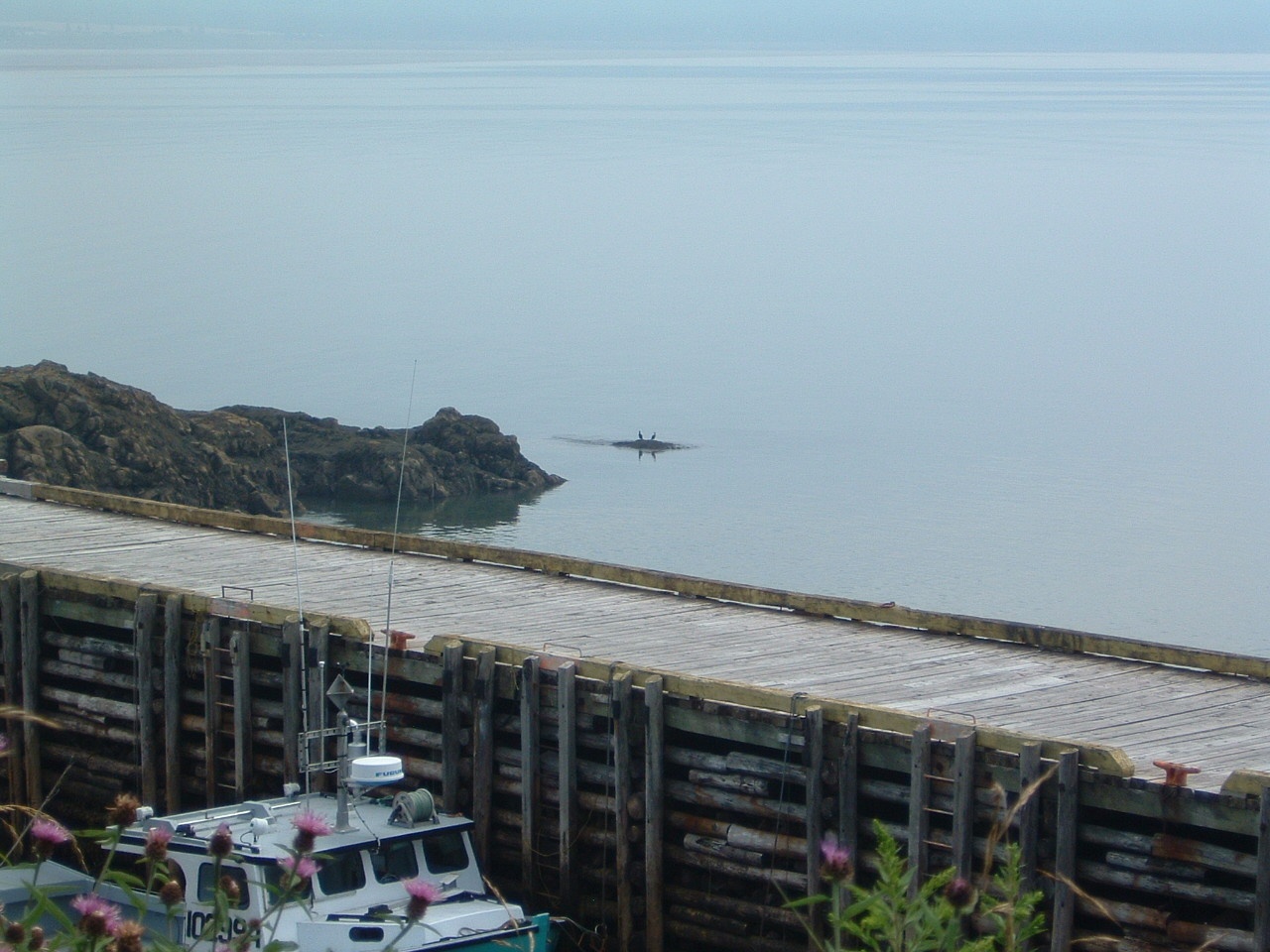
We all should have a day to play! My daughter and I beachcombed on three different beaches, nearly getting stranded in one place which was quite funny although it could have been a real problem. The tides of the Atlantic here in Nova Scotia are the highest in the world – for more information on that refer to this post.

I had just explained to my daughter how it was when I was a kid and we would go to Mum’s relatives’ home for summer vacations. They lived very close to the bay, in fact, it was a short few minutes’ walk to the shore. (What a marvellous place for a child to spend a week or two of one’s summer!)  My daughter parked the car, we walked up over a little bridge and onto a pebbly raised beach to start more beachcombing. After walking a few minutes I looked back and commented to my daughter, “Look how much the water has risen!” When she looked where I was indicating, she exclaimed, “Oh my gosh! Look how high the water is! We have to move the car!” Laughing as we went, we hurried back and waded through water where it had been dry only minutes before. We warned other people there, but the tide was coming in so quickly some may not have been as fortunate as we were. We hoped their engines weren’t under water by the time they could get to their cars, but we couldn’t stay to find out as we had to be elsewhere by a certain time. They weren’t left alone, though, as there were a few other people still there. I told my daughter most people don’t understand how quickly the tide comes in there; years before Mum’s cousin occasionally would have to go out in his boat and rescue people who had been caught off guard.

dscf00281.jpg

The above shows low tide, and when the tide comes in you can step right out onto that boat.

Oh, how I love the ocean! I have a short, fun video clip of our little adventure but I’m disappointed that I can’t open it to put here to share with you.

Now please tell me: What fun – unexpected or planned – adventures did you enjoy this summer?

Thanks for reading, and … Creative Musings!  🙂


Sue Harrison’s “Writing the Third Dimension” – part 8: Patchwork

Welcome! Over the next many months we invite you to return here, specifically on the fourth Thursday of each month for the newest installment of Sue Harrison‘s teaching: Writing The Third Dimension. You can read all the segments by clicking on the page title WRITING THE THIRD DIMENSION, found under Writers’ Helps & Workshops on the drop-down menu. Please feel free to ask questions and leave comments for Sue. Now for the topic for month eight:

******

“Writing the Third Dimension” – part 8: Patchwork

When I was about seven years old, my Grandma Kate made me a quilt for my doll. Exquisitely pieced with tiny hand stitches, that quilt is one of my most precious possessions. Each square is about one inch by one inch, and scattered throughout are squares that are plain red, but the other squares are from my grandmother’s dresses, and my grandfather’s shirts and pajamas. The variety is lovely, and the red squares, although scattered without a fixed design, unite the others into a cohesive whole. As I write this, the quilt lies in the center of my dining room table, background for a lovely piece of Belgian lace and an old-fashioned-looking oil lamp. I smile each time I look at the table. What a treasure my grandmother gave to me.

P7010047

Writers also need to use patchwork as they compose their novels. Last month in my Writing the Third Dimension blog post, I explained how important it is to allow readers to “see” most description through the characters’ eyes, rather than as a narration from the writer’s point-of-view. I did mention that there were exceptions, and that’s what we’ll discuss today – exceptions. Legitimate reasons exist for brief patchwork bits of narration that don’t come directly from a character’s viewpoint. Here are the most common:

1. At the beginning of a novel before a character is introduced. It’s very tempting to write a page or two or three, but this type of narration should be limited to a sentence or two or three. Otherwise, your reader is going to get bored and stop reading before getting into the real story.

2. To allow a reader to catch his or her breath in a very intense, suspenseful scene. A sentence is usually enough to do the trick and give a pacing pause that actually increases the suspense for most readers.

3. When the reader needs a quick “you are here” logistical placement.

4. If you are using multiple points-of-view within your novel, and you are moving the narrative out of one character’s head, or point-of-view, into another’s. Without that bit of even ground between, it’s uncomfortable and confusing for the reader.

5. If there is some information that your point-of-view character does not know (a bit of history or even something that will happen in the future), but that will enrich your reader’s experience. This is tricky and shouldn’t happen often within a novel, if at all. Again use that one- to three-sentence limit to keep your reader in the story.

6. The information you are presenting doesn’t merit more than a sentence.

Novelists will find themselves confronted with nearly all of these situations in each book they write. They’re the ‘patchwork’ stuff, but as the writer you don’t want them to sound patchy. You want them to blend in, and the best way to do that is the same way a good quilter sews a quilt – with tiny inconspicuous stitches.

Okay, I can hear your question right now. What does that mean within the context of a novel?

1. Don’t get out your thesaurus. Use normal everyday words.

2. Make your point and then jump into a character’s point-of-view or a dialog.

3. Avoid complex sentences.

There you have it. A reason to break the rules and how to do so inconspicuously. Maybe it’s time to add here that one of the biggest mistakes new novelists make is adhering too rigidly to the rules, and someday we’ll talk about that, too!

My question for you: When you give someone directions or describe something, do you tend to be long-winded or to-the-point?

Sue

*Writing the Third Dimension, copyright, 2010 Sue Harrison*

Sue HarrisonBestselling author, Sue Harrison, has written two Alaska trilogies: The Ivory Carver Trilogy and The Storyteller Trilogy, and a middle readers’ book SISU. Prior to the publication of her novels, Harrison was employed at Lake Superior State University as a writer and acting director of the Public Relations Department and as an adjunct instructor in creative writing and advanced creative writing. For more information, click here. To inquire about booking Sue for workshops or speaking engagements this year, click here.

Thanks for joining us! Please feel free to leave your questions and comments. We invite you come back September 26, 2013 for part 9.

Sue Harrison’s “Writing the Third Dimension” – part 7: I or He or is it Me?

Welcome! Over the next many months we invite you to return here, specifically on the fourth Thursday of each month for the newest installment of Sue Harrison‘s teaching: Writing The Third Dimension. You can read all the segments by clicking on the page title WRITING THE THIRD DIMENSION, found under Writers’ Helps & Workshops on the drop-down menu. Please feel free to ask questions and leave comments for Sue. Now for the topic for month seven:

******

“Writing the Third Dimension” – part 7: I or He or is it Me?

Decisions, decisions…

When you are writing a novel,  decisions are part of the process. One of the most important decisions you as a novelist have to make is how to present your main character(s) to your readers. That presentation is commonly known as point-of-view. You will see point-of-view abbreviated in many writers’ blogs and how-to books as pov.

With pov you have two basic choices – first person point-of-view and third person point-of-view.

I went for a walk, and I met my enemy. First person pov

He went for a walk, and he met his enemy. Third person pov

Now you can get a little fancy or funky and use second person, but second person (You go for a walk and you meet your enemy.) is generally used within the context of a first person point-of-view presentation or, on occasion, to convey the thoughts of a character being presented in the third-person-point-of-view. So we’ll delegate a discussion of second person point-of-view to  another time and another place.

To make your pov decision, you need to know what each pov offers to your novel, because they both have strengths and weaknesses. Let’s talk about some of those.

First Person Point-of-View Strengths:

  • First person generally pulls the reader into the protagonist’s mind more quickly, so the reader identifies more easily with the main character.
  • First person is often best for readers who prefer their novels to follow only one main character.
  • First person is usually (not always) the POV of choice for literary novels because stream-of-consciousness and an unusual “voice” (My next “Writing the Third Dimension” will be about voice.) are often very important to literary novels, and for most novelists stream-of-consciousness and an unusual voice are more easily achieved through first person pov presentations.
  • First person is often used for mysteries in which the novelist wants both the reader and the protagonist to be struggling to figure out who-dun-it.
  • Novelists who write in the young adult genre often use first person pov because a certain percentage of their readers are not reading by choice. They are reading by assignment, and thus they are more antagonistic to characters and plot. A first person presentation, with its limited pov and strong emotional pull, captures them more easily.

Third Person Point-of-View Strengths:

  • In multi-character novels with a wide historical or geographic scope, third person pov makes for an easier presentation of extensive ideas and a wide variety of cultures and characters.
  • With third person pov, the reader feels more distance between himself/herself and the characters, which means the writer can more readily present some of the action through the eyes and mind of a villain without grossing out a sensitive reader. This is a who-is-your-audience situation and will depend on your novel’s genre. In the horror genre, writers don’t hesitate to convey a villain’s thoughts from a first person pov. In an inspirational genre, that might not work so well.
  • In some suspense and mystery novels, the writer wants the reader to know what is going on while the protagonist remains clueless. In third person pov, secondary characters can provide information through conversations or thoughts that are presented to the reader but not to  the protagonist.

First Person Point-of-View Weaknesses:

  • Some readers refuse to read books written in first person pov. This is a personal preference, but I’ve yet to find a reader who refuses to read a book written in third person pov.
  • The writer can’t suddenly hop into another character’s mind in first person pov. If the character telling the story doesn’t know some fact, that character can’t suddenly present that fact to the reader. Now I know there are successful exceptions to this rule, but 98% of the time, in first person pov, if the main character doesn’t know something then it can’t be presented to the reader.
  • In first person pov, it’s very easy to fall into “telling” the story rather than “showing” what’s going on. If this concept is confusing to you, please refer to my last “Writing the Third Dimension” post (June 2013)  entitled “20/20.”

Third Person Point-of-View Weaknesses:

  • In third person pov, it sometimes takes a reader longer to feel an emotional bond with the main characters.
  • Novels written in third person are often more complex in plot, which for some readers is a disadvantage.

When I’m deciding which point-of-view to use in a short story or a novel, I sometimes write the first chapter both ways. Then I can tell which one flows better, and I make my decision according to that.

Point-of-view is a complex topic, so, if I’ve managed to do nothing more than confuse you, please feel free to ask questions. Otherwise, as a reader, do you have a preference – first person point-of-view or third person point-of-view?

Sue

*Writing the Third Dimension, copyright, 2010 Sue Harrison*

Sue HarrisonBestselling author, Sue Harrison, has written two Alaska trilogies: The Ivory Carver Trilogy and The Storyteller Trilogy, and a middle readers’ book SISU. Prior to the publication of her novels, Harrison was employed at Lake Superior State University as a writer and acting director of the Public Relations Department and as an adjunct instructor in creative writing and advanced creative writing. For more information, click here. To inquire about booking Sue for workshops or speaking engagements this year, click here.

Thanks for joining us! Please feel free to leave your questions and comments. We invite you come back August 22, 2013, for part 8.

Sue Harrison’s “Writing the Third Dimension” – part 6: 20/20 vision

Welcome! Over the next many months we invite you to return here, specifically on the fourth Thursday of each month for the newest installment of Sue Harrison‘s teaching: Writing The Third Dimension. You can read all the segments by clicking on the page title WRITING THE THIRD DIMENSION, found under Writers’ Helps & Workshops on the drop-down menu. Please feel free to ask questions and leave comments for Sue. Now for the topic for month six:

******

“Writing the Third Dimension” – part 6: 20/20

This post is one of the most important in our series, “Writing The Third Dimension,” so “listen up” (as one of my favorite teachers used to say.)  Employing the following technique can turn an ordinary novel into that book you just can’t put down.

For years this technique was a secret owned by only the most elite bestselling novelists, but then somebody normal – like you and me – figured it out, and now we can all use it to our advantage. Hooray!

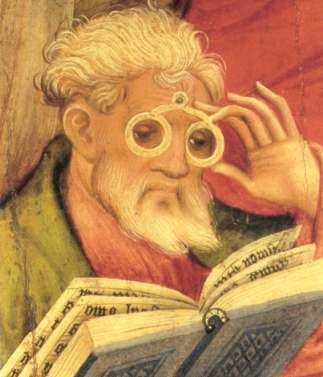
File:Conrad von Soest, 'Brillenapostel' (1403).jpg

That secret is to allow the reader to see life through the 20/20 vision of the character’s eyes instead of the one-person-removed vision of the author. It’s all about showing, not telling. Showing is more difficult to do, but every time an author forsakes the showing approach for the easier and quicker I’ll-just-tell-you method, the reader is shortchanged and the story suffers.

Compare these two paragraphs: (Warning: neither one is great literature. I’m just trying to prove my point!)

1) A deep scum-covered pond lapped against the steps of the back porch. The whole house leaned toward the water as though it would someday sink beneath the dark surface. A tangle of willow trees grew at the edges of the pond, obscuring it from anyone on the road.

2) Devon stepped out on the back porch. His throat tightened. The whole backyard was a dark scum-covered pond. Water lapped against the porch steps, and Devon felt his feet slide against the rotting boards. He grabbed the porch rail. He couldn’t swim. If he fell in, he would never get out, and the tangle of willow that grew around the pond was so thick that no one on the road would ever see him.

Paragraph one doesn’t pull you in like paragraph two. Why? Paragraph one is description only. Paragraph two adds the sweet spice of emotion, because the reader is seeing the scene through the character’s eyes.

It’s hard for an author to admit, but characters are usually a lot more interesting than any author ever could be. When my readers pick up one of my novels about Alaska, 7000 B.C., they  don’t want to hear about it from someone who has never been there (like Sue Harrison). They want to hear about it from someone who is living there right now (like the woman Chagak in Mother Earth Father Sky).

I suggest that you practice the writing skill of showing-not-telling by looking through your own manuscript or through a book you are reading. When you find a paragraph of pure description (There are times when pure description is needed – a later post about that!) , rewrite it from a character’s up-close, 20/20, emotion-drenched point of view!

Have fun! Any questions?

Sue

*Writing the Third Dimension, copyright, 2010 Sue Harrison*

Sue HarrisonBestselling author, Sue Harrison, has written two Alaska trilogies: The Ivory Carver Trilogy and The Storyteller Trilogy, and a middle readers’ book SISU. Prior to the publication of her novels, Harrison was employed at Lake Superior State University as a writer and acting director of the Public Relations Department and as an adjunct instructor in creative writing and advanced creative writing. For more information, click here. To inquire about booking Sue for workshops or speaking engagements this year, click here.

Thanks for joining us! Please feel free to leave your questions and comments. We invite you come back July 25, 2013, for part 7.

Saving lives

My sincere apologies for not posting lately. I’m feeling a little overwhelmed and a lot tired.  I do have a little story to tell you today, though.

A few weeks ago I went along with my daughter and young grandson to the magnificent performance of Beauty and the Beast. It was a wonderfully executed musical with excellence in the acting, dancing, singing, sets, costuming, lighting … and everything I may have missed mentioning. (My only complaint was regarding the small restless child seated behind me who whined, kicked my seat and somehow managed to kick me a few times over the top of my seat. Fortunately that didn’t last.)

At first my grandson didn’t seem all that impressed when it began with a short narrative, but once the ‘show’ got underway he didn’t move his attention from the stage. It was that good.

Beauty and the Beast

If you know the story of Beauty and the Beast, you know Belle’s love is what saved the Beast so after he died he again lived to become who he really was. (Reminds me of the Christian experience of grace.)

The ending of this live performance got to me; it was so beautifully done in such a touching way. I confessed to my daughter afterward, “I got tears in my eyes at the end.” She replied, “Me too! I was thinking don’t look at me!”  🙂

Now you may be wondering about the title of this post … Saving lives.  It was on the way home we got to be part of another dramatic live-saving adventure.

Part of our hour-long drive from the city to home is on a divided highway, three lanes both ways. As we drove along we noticed traffic in our lane was slowing a little and pulling out around something. My daughter was driving and suddenly exclaimed, “A mother duck and her babies!” On our left side – which was next to the median – there was a duck and her nine ducklings, waddling along in the same direction as the traffic. She obviously wanted to get up over the median, then would change her mind, and instead move into traffic in our lane. Her babies were staying very close to her, except for one little fellow that literally fell behind. It toppled over, got up again, and waddled even faster to catch up. So cute, and very stressful for us watching and worrying about them getting run over.

My daughter pulled on her four-ways (emergency signal lights) and slowed since they were then right in front of us. Eventually all traffic in our three lanes came to a stop, and a man in a van two lanes over, and I, got out to direct the duck family across all three lanes to a ditch. A second man from another vehicle joined us so they could not go off in the wrong direction.

I told my grandson the mother duck could have flown up over the median but her babies couldn’t fly yet and she wouldn’t leave them. It was quite an example of dedication for him to witness.

The duck rescue was a stressful, exhilarating, satisfying experience. When I told my husband about it later he said if the police had come along I could have been ticketed for stopping traffic on a main series highway. If that is true then I would not have been the only one. (Please don’t tell on me. 😉 )

I checked on YouTube and found many similar incidences, but they were captured on video whereas we didn’t even get pictures. Oh well, you will just have to believe me.

I did find this video that will take your breath away, as must have happened to this unfortunate – or fortunate, depending on how you look at it – family of ducks. (I hope the video works for you.)

Have you done anything crazy or daring to save a life or help someone out? I’d love to hear about it.

Thanks for reading, and … Creative Musings!  🙂

Sue Harrison’s “Writing the Third Dimension” – part 5: CRASH! SMASH!

Welcome! Over the next many months we invite you to return here, specifically on the fourth Thursday of each month for the newest installment of Sue Harrison‘s teaching: Writing The Third Dimension. You can read all the segments by clicking on the page title WRITING THE THIRD DIMENSION, found under Writers’ Helps & Workshops on the drop-down menu. Please feel free to ask questions and leave comments for Sue. Now for the topic for month five:

******

“Writing the Third Dimension” – part 5: CRASH! SMASH!

When my oldest brother was in grade school, he discovered the delight of racing little plastic cars on a miniature track. He and my dad would each take a car and a controller and race and race and race. The winner was always elated, but I think they had the most fun when one of the cars would accidentally fly off the track, crash into the other car, and carry it off across the room, plastic parts flying.

If you are a writer, there’s a lesson to be learned in the art of crashing.  Novelists need to be experts at destruction, specifically, the destruction of their main character’s heart. We touched on this subject in my first Writing the Third Dimension post, but we need to dig a bit deeper into the process.

If you have a good understanding of your main character’s self-image issues (See Part 1 of Writing the Third Dimension: Heart Breaker), it’s time for you to take that wonderful person (or horrible person, if we’re talking about the villain)  and rip his or her world apart. You have to grab whatever that person loves most and smash it to smithereens. If you have a complex novel, with several main characters and a villain or two, you need to do that smashing stuff with every one of them.

Here are a few tips about smashing:

1. Your character’s central self-image can be smashed at any time in the novel, or even before the novel begins, but I’ve found the most effective smashing usually occurs within the first few chapters.

2. If you destroy your main character’s self-image BEFORE the novel begins, avoid the temptation to TELL the reader all about it in the first chapter. Or in the second chapter. Or ever in the novel. Feed it to your reader in small tasty bites. (We’ll discuss how to do this in a future post.)  Your reader wants to guess a bit about why the main character acts, talks, and defines the world as he does.

3. The most effective smashing occurs after the reader has bonded with the character.  Your reader will best bond through emotions.  In the first few chapters, the reader wants to know what your character loves, what your character enjoys, what your character hates. Let your reader see your character’s heart. Then SMASH! In my novel, Mother Earth Father Sky, I dedicated the first chapter to opening the main character’s world to the reader. It is a world foreign to most people because the novel takes place thousands of years ago in Alaska, but, by the end of the chapter, the reader knows that the main character, Chagak, is a young woman in love with the man who has just arranged to marry her. The reader learns that Chagak holds a place of respect in the village and is close to her parents and siblings. Then SMASH! Her whole world is destroyed by marauders, and she is the sole survivor.  Which brings us to point number 4.

4. Smashing hurts your heart. Be ready for that. If you don’t shed tears for your characters, your readers won’t shed tears either.

5. In longer, more complex novels, your main character may experience several SMASH situations in his or her life. A good example of this is the classic novel, Jane Eyre by Charlotte Bronte. Jane’s world crashes when, as a child, she must go live with her self-serving aunt and wicked cousins. It crashes again when she loses her best friend at boarding school, and it crashes yet again when she uncovers the great secret hidden by the love of her life.  Charlotte Bronte was a master at pulling her readers in by destroying her characters’ worlds.

Likewise, your novel will pull in your readers when you make judicious use of the art of crashing.

How do you feel about smashing? Are you good at destroying your characters’ worlds, or is that difficult for you?

Blessings and Happy Writing!

Sue

*Writing the Third Dimension, copyright, 2010 Sue Harrison*

Sue HarrisonBestselling author, Sue Harrison, has written two Alaska trilogies: The Ivory Carver Trilogy and The Storyteller Trilogy, and a middle readers’ book SISU. Prior to the publication of her novels, Harrison was employed at Lake Superior State University as a writer and acting director of the Public Relations Department and as an adjunct instructor in creative writing and advanced creative writing. For more information, click here. To inquire about booking Sue for workshops or speaking engagements this year, click here.

Thanks for joining us! Please feel free to leave your questions and comments. We invite you come back June 27, 2013 for part 6.