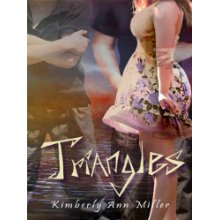
Book Review: Triangles – by Kimberly Ann Miller

Triangles - Kimberly Ann MillerBook: Triangles
Author: Kimberly Ann Miller
Publisher: Spencer Hill Press
Date: June 18, 2013
Genre: young adult
Pages: 216
Price: $9.95
My rating: a fairly good read based on a fascinating concept


I received this book (ARC) from the publisher in exchange for my honest review.

This story is told mostly from the point-of-view of a seventeen-year-old girl, Autumn, who is an unhappy complainer. She gives her sister a hard time, their dad died, their mother is very ill, and we find out she is not happy about a nice guy who is constantly bestowing her with little gifts at work – which she rewards by attempting to get rid of his attention through her rude behaviour toward him.

When Autumn agrees to go on a cruise with her sister she does so with reluctance. It was what she thought would be a good temporary escape, a chance to get away from the pain they are going through in their family life. What she gets on this cruise is a trip through the Bermuda Triangle that is confusing and very strange.

Each time Autumn has an alternate reality experience she is as shocked as before, even though she is aware it is happening. Her life gets more messed up each time a change occurs, but it doesn’t change her rude and hateful attitude.

The author did a convincing job of making Autumn an unlikeable person and – if I remember correctly – she is the only one in the book to use bad language. She comes across as crude, rude, and a hateful brat a lot of the time.

On this cruise she is pursued by two guys, and in each alternate reality shift they also change in personality and circumstance. Terrible things happen, confusing things happen, surprising things happen, and Autumn’s fear is that she will be trapped in the Bermuda Triangle forever and not be able to live the life she is learning she really wants.

Triangles – by Kimberly Ann Miller – is a fairly quick read. The mystery of the Bermuda Triangle is a fascinating topic to write a fictional young adult novel around. Although a few places did not make sense to me and tripped me up a bit, the idea of someone getting caught in the Triangle and living through it is an interesting one. It certainly makes the reader think.

You can find Triangles listed on my BUY THE BOOK! page.

Thanks for reading, and … Creative Musings!  🙂

‘Read More Books’ Challenge: Week 2: 53-103 of the list of 623 of the best books ever!

Are you ready for week two of our Read More Books challenge?

Read HERE to learn about it. It’s not too late to join in.

Check WEEK ONE of the list if you missed it.

There were a few responses to week one’s challenge. How did you do with your reading? Even if you didn’t finish the book you selected, it counts if you select one for this week to add to your TBR pile.

Here is week two’s list of 52 books:

53. A Prayer for Owen Meany — by John Irving
54. Emma — by Jane Austen
55. David Copperfield — by Charles Dickens
56. The Portrait of a Lady — by Henry James
57. The Trial — by Franz Kafka
58. Crime and Punishment — by Fyodor Dostoyevsky
59. A Clockwork Orange — by Anthony Burgess
60. The Age of Innocence — by Edith Wharton
61. Don Quixote — by Miguel de Cervantes
62. As I Lay Dying — by William Faulkner
63. His Dark Materials — by Philip Pullman
64. Brideshead Revisited — by Evelyn Waugh
65. The Golden Notebook — by Doris Lessing
66. Adventures of Huckleberry Finn — by Mark Twain
67. Things Fall Apart — by Chinua Achebe
68. Tom Jones — by Henry Fielding
69. Harry Potter and the Philosopher’s Stone — by J. K. Rowling
70. Song of Solomon — by Toni Morrison
71. Molloy; Malone Dies; The Unnamable — by Samuel Beckett
72. Finnegans Wake — by James Joyce
73. Absalom, Absalom! — by William Faulkner
74. The Life and Opinions of Tristram Shandy, Gentleman — by Laurence Sterne
75. Charlotte’s Web — by E. B. White
76. The Ambassadors — by Henry James
77. Sons and Lovers — by D. H. Lawrence
78. A Farewell to Arms — by Ernest Hemingway
79. Women in Love — by D. H. Lawrence
80. Birdsong — by Sebastian Faulks
81. Gulliver’s Travels — by Jonathan Swift
82. Watership Down — by Richard Adams
83. Gravity’s Rainbow — by Thomas Pynchon
84. Frankenstein — by Mary Shelley
85. Clarissa: Or the History of a Young Lady — by Samuel Richardson
86. The Old Man and the Sea — by Ernest Hemingway
87. Dune — by Frank Herbert
88. The Life and Adventures of Robinson Crusoe — by Daniel Defoe
89. Go Tell It on the Mountain — by James Baldwin
90. All the King’s Men — by Robert Penn Warren
91. The Magic Mountain — by Thomas Mann
92. The Call of the Wild — by Jack London
93. The Tin Drum — by Gunter Grass
94. The 42nd Parallel — by John Dos Passos
95. Under the Volcano — by Malcolm Lowry
96. Disgrace — by J. M. Coetzee
97. The Diary of a Young Girl — by Anne Frank
98. Bleak House — by Charles Dickens
99. Light in August — by William Faulkner
100. Scarlet Letter — by Nathaniel Hawthorne
101. Pale Fire — by Vladimir Nabokov
102. Captain Corelli’s Mandolin — by Louis de Bernieres
103. Howards End — by E. M. Forster
 
From the above list:
  • Which books have you read?
  • Which books do you want to read?
  • Which books are you going to obtain this week?(Even if you are not officially taking the Read More Books challenge I would love to hear about your reading.)

Note: I got permission to share this list on my blog. (Thank you, Stuart!) You could go HERE for the list of “623 of the best books ever written” and see them all at once for yourself, and/or you can follow the list here a few at a time.

Thanks for reading, and … Creative Musings! 🙂

When Reality smacks you upside the head

Reality bites. hard. Ever notice?

Saturday was one of those reality check days.

Last week was full of beautiful weather days, so when it worked out for us to take a drive to visit someone we love we took that opportunity. It was time for us to visit. She has been failing quickly; each time they brought her to visit us this year there has been a marked difference. Now that she was recently moved into a nursing home (a very good one) it was our turn to go to her.

The three of us got off to a late morning start, directions in hand. By the time we arrived in the area, almost an hour later, we thought she would soon be having her lunch and we didn’t want to interrupt. It was about 11:40 so we found a little seafood restaurant and took our time there.

The instructions we had been given were easy to follow and it wasn’t long before we got pointed in the right direction again. Soon we found the creatively designed, tastefully decorated building – our destination – set back from the busyness of traffic and away from city life. Besides the alternating attractive colour scheme, we noticed high iron gates around well-kept garden sitting areas. It was immediately noticeable that no residents could wander off and get lost or harmed.

After we made our way through security – a must-have feature for this type of nursing home – we found our way to the second level and down winding halls with paintings on the walls and nautical-named units. Upon entering her section we were told she was in the dining area. That’s when reality met us head-on.

Up until that time we knew she had become frail, more and more confused and forgetful, and recently very restless which made it too difficult to keep her safe at home. (If you know much about Alzheimer’s disease then you understand what I’m saying. I’m leaving out a lot.) We were not prepared to see her being fed her lunch. We were not prepared to see this loved one, when taken back to her room where we waited to visit with her, seemingly hardly aware of our presence.

What we expected was to be able to converse with her on some level. We expected to have a conversation that would be disjointed, even nonsensical, perhaps, but at least some kind of communication once she sorted out – even temporarily – who we are. I was prepared for her to not remember me even though she has known me all my life; I could have handled that. That is not what we found. What we found was the cold hard reality of advancing Alzheimer’s. Our sweet, funny, fun-loving, precious loved one is getting away from us. Through the medication that helps to keep her calm and safely and respectably manageable she seems to be fighting to hold on to who she really is, but it is a battle no one yet has been able to win. That is the horror of it. That is reality. Cold. hard. reality.

It was emotional for the three of us. One of us visiting her that day is on the same path, although not as far along. We don’t know if it registered with him that what he witnessed – a journey taken by his father decades before, then his younger brother, and now his youngest sister – is also the strong possibility of where his journey will take him. We don’t know. We won’t ask.

Our drive home was more subdued, conversation minimal, each of us travelling with our own thoughts.

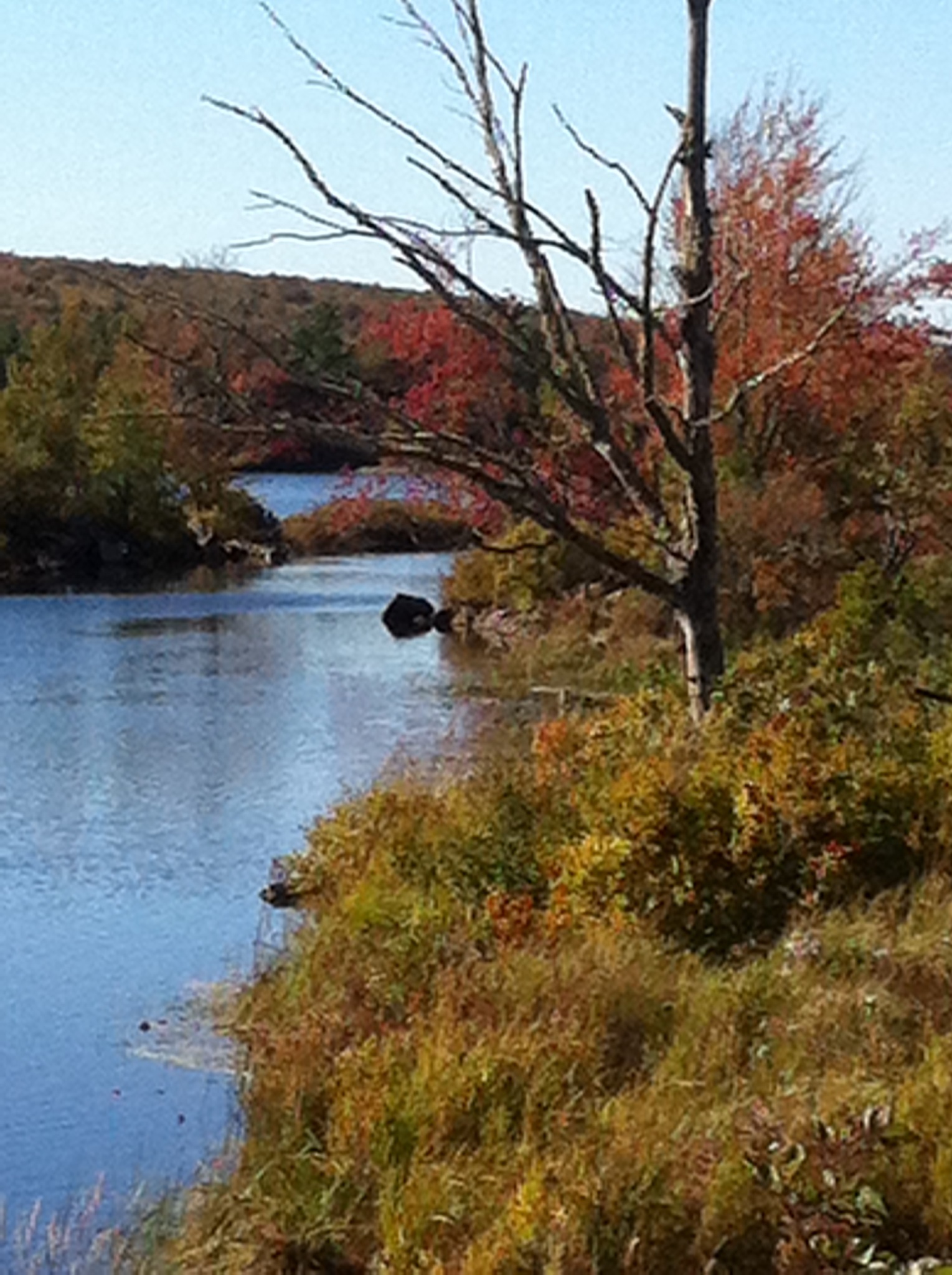
A few hours earlier I was noticing how lovely our Autumn colours are as the leaves are changing from their greens to reds, yellows, and orange hues. I was admiring and thankful for God’s handiwork in the beauty around us. On the drive back home I noticed everything in sharper little snapshots.

Autumn colours

gorgeous displays of colourfully painted leaves, click!

the dull grey of dead tree limbs set against the blue sparkle of a pond, click!

streaks and layers of a rippled blanket of clouds laid across the sky in various shades of grey and white, click!

muddy tidal waters filling a river, click!

stands of tall dead grasses, click!

the small bright green car driving in an oncoming lane, click!

Each place I looked seemed to have its own glory, as if my mind was grasping everything in new awareness, capturing little moments of wonder after a time of sadness. Funny how the mind does that. It’s as if God was reminding me … 

This is reality, too. Enjoy it.

Post Script: I learned while writing this post that she did have a memory of his being there to visit her, and that is good.

Comments? Anything to share?

Thanks for reading, and … Creative Musings!  🙂

‘Read More Books’ Challenge: Week 1: 1-52 of the list of 623 of the best books ever!

Are you ready for the challenge?

Thanks to Erik of This Kid Reviews Books, my challenge now has a name: Read More Books Challenge.

Please go to THIS SHORT POST first if you don’t know what I’m talking about.

MY OFFER

Because I know you love to read – or read and write – I have decided to give you the list I found, and I got permission to do so. (Thank you, Stuart!) You could go HERE for the list of “623 of the best books ever written” and see them all at once for yourself, and/or you can follow the list here a few at a time.

The reason I thought you might enjoy the list in sections is so that you can see which ones you have already read – a few at a time – and then —

MY CHALLENGE

… you will have a week to buy or borrow the ones you want to read before my next installment of more of the list. I was going to divide it between six posts, but changed that to twelve posts because the shorter lists are easier to work with if you want to shop for a book each week. How’s that for a little incentive for those of us who can find time to read more often? Besides, it might be fun! 🙂 And who doesn’t appreciate an excuse to book shop?

Each Thursday I will post another portion of the list of “623 of the best books ever written” until we get to the end of twelve posts. NOTE: On the fourth Thursday of each month it will not be posted because we have Sue Harrison’s writers workshop that day – and I don’t want to mess with a good thing!

Here are the first 52 books of “623 of the best books ever written” as compiled and listed on a list of books website.

  1. The Great Gatsby — by F. Scott Fitzgerald
  2. The Grapes of Wrath — by John Steinbeck
  3. Nineteen Eighty-Four — by George Orwell
  4. Ulysses — by James Joyce
  5. Lolita — by Vladimir Nabokov
  6. Catch-22 — by Joseph Heller
  7. The Catcher in the Rye — by J. D. Salinger
  8. Beloved — by Toni Morrison
  9. The Sound and the Fury — by William Faulkner
  10. To Kill a Mockingbird — by Harper Lee
  11. The Lord of the Rings — by J. R. R. Tolkien
  12. One Hundred Years of Solitude — by Gabriel Garcia Márquez
  13. Brave New World — by Aldous Huxley
  14. To The Lighthouse — by Virginia Woolf
  15. Invisible Man — by Ralph Ellison
  16. Gone With The Wind — by Margaret Mitchell
  17. Jane Eyre — by Charlotte Brontë
  18. On The Road — by Jack Kerouac
  19. Pride and Prejudice — by Jane Austen
  20. Lord of the Flies — by William Golding
  21. Middle March — by George Eliot
  22. Anna Karenina — by Leo Tolstoy
  23. Animal Farm — by George Orwell
  24. A Passage to India — by E. M. Forster
  25. In Search of Lost Time — by Marcel Proust
  26. Wuthering Heights — by Emily Brontë
  27. The Chronicles of Narnia — by C. S. Lewis
  28. The Color Purple — by Alice Walker
  29. Midnight’s Children — by Salman Rushdie
  30. A Portrait of the Artist as a Young Man — by James Joyce
  31. Winnie-the-Pooh — by A. A. Milne
  32. Heart of Darkness — by Joseph Conrad
  33. Mrs Dalloway — by Virginia Woolf
  34. Slaughterhouse-Five — by Kurt Vonnegut
  35. War and Peace — by Leo Tolstoy
  36. Of Mice and Men — by John Steinbeck
  37. Moby-Dick — by Herman Melville
  38. Little Women — by Louisa Mae Alcott
  39. Native Son — by Richard Wright
  40. The Hitchhiker’s Guide to the Galaxy — by Douglas Adams
  41. Great Expectations — by Charles Dickens
  42. The Sun Also Rises — by Ernest Hemingway
  43. Rebecca — by Daphne du Maurier
  44. The Stranger — by Albert Camus
  45. Alice’s Adventures in Wonderland and Through the Looking Glass — by Lewis Carroll
  46. For Whom the Bell Tolls — by Ernest Hemingway
  47. The Hobbit — by J. R. R. Tolkien
  48. Madame Bovary — by Gustave Flaubert
  49. The Wind in the Willows — by Kenneth Grahame
  50. The Handmaid’s Tale — by Margaret Atwood
  51. Tess of the D’Urbervilles — by Thomas Hardy
  52. Their Eyes Were Watching God — by Zora Neale Hurston

From the above list:

  • Which books have you read?
  • Which books do you want to read?
  • Which books are you going to obtain this week?(Even if you are not taking the challenge I would love to hear about your reading.)

Thanks for reading, and … Creative Musings! 🙂

The Case for Good Taste in Children’s Books – (reprinted by permission)

It has been very hard for me to “buckle down” and “just write”, likely because I feel used up in one way or another almost every day. I’m trying to get back into blogging more because I enjoy it and because I hope I’m posting things of help to you, my readers.

The following article is long but one worth sharing, and I’m doing so with permission. You can check out the publication in which it’s printed: here.

PLEASE NOTE: THIS ARTICLE IS NOT INTENDED FOR YOUNG READERS BECAUSE OF SOME OF ITS CONTENT.

The Case for Good Taste in Children’s Books MEGHAN COX GURDON has been the children’s book reviewer for the Wall Street Journal since 2005. Her work has also appeared in numerous other publications, including the Washington Post, the Washington Examiner, the San Francisco Chronicle, National Review, and the Weekly Standard. In the 1990s, she worked as an overseas correspondent in Hong Kong, Tokyo, and London, and traveled and reported from Cambodia, Somalia, China, Israel, South Korea, and Northern Ireland. She graduated magna cum laude from Bowdoin College in 1986 and lives near Washington, D.C., with her husband and their five children.The following is adapted from a speech delivered at Hillsdale College on March 12, 2013, sponsored by the College’s Dow Journalism Program.ON JUNE 4, 2011, the number one trending topic on Twitter was the Anthony Weiner scandal. I happen to remember that, because the number two topic on Twitter that day—almost as frenzied, though a lot less humorous—had to do with an outrageous, intolerable attack on Young Adult literature . . . by me. Entitled “Darkness Too Visible,” my article discussed the increasingly dark current that runs through books classified as YA, for Young Adult—books aimed at readers between 12 and 18 years of age—a subset that has, in the four decades since Young Adult became a distinct category in fiction, become increasingly lurid, grotesque, profane, sexual, and ugly.Books show us the world, and in that sense, too many books for adolescents act like funhouse mirrors, reflecting hideously distorted portrayals of life. Those of us who have grown up understand that the teen years can be fraught and turbulent—and for some kids, very unhappy—but at the same time we know that in the arc of human life, these years are brief. Today, too many novels for teenagers are long on the turbulence and short on a sense of perspective. Nor does it help that the narrative style that dominates Young Adult books is the first person present tense—“I, I, I,” and “now, now, now.” Writers use this device to create a feeling of urgency, to show solidarity with the reader and to make the reader feel that he or she is occupying the persona of the narrator. The trouble is that the first person present tense also erects a kind of verbal prison, keeping young readers in the turmoil of the moment just as their hormones tend to do. This narrative style reinforces the blinkers teenagers often seem to be wearing, rather than drawing them out and into the open.

Bringing Judgment

The late critic Hilton Kramer was seated once at a dinner next to film director Woody Allen. Allen asked him if he felt embarrassed when he met people socially whom he’d savaged in print. “No,” Kramer said, “they’re the ones who made the bad art. I just described it.” As the story goes, Allen fell gloomily silent, having once made a film that had received the Kramer treatment.

I don’t presume to have a nose as sensitive as Hilton Kramer’s—but I do know that criticism is pointless if it’s only boosterism. To evaluate anything, including children’s books, is to engage the faculty of judgment, which requires that great bugbear of the politically correct, “discrimination.” Thus, in responding to my article, YA book writers Judy Blume and Libba Bray charged that I was giving comfort to book-banners, and Publisher’s Weekly warned of a “danger” that my arguments “encourage a culture of fear around YA literature.” But I do not, in fact, wish to ban any books or frighten any authors. What I do wish is that people in the book business would exercise better taste; that adult authors would not simply validate every spasm of the teen experience; and that our culture was not marching toward ever-greater explicitness in depictions of sex and violence.

Books for children and teenagers are written, packaged, and sold by adults. It follows from this that the emotional depictions they contain come to young people with a kind of adult imprimatur. As a school librarian in Idaho wrote to her colleagues in my defense: “You are naïve if you think young people can read a dark and violent book that sits on the library shelves and not believe that that behavior must be condoned by the adults in their school lives.”

What kind of books are we talking about? Let me give you three examples—but with a warning that some of what you’re about to hear is not appropriate for younger listeners.

A teenaged boy is kidnapped, drugged, and nearly raped by a male captor. After escaping, he comes across a pair of weird glasses that transport him to a world of almost impossible cruelty. Moments later, he finds himself facing a wall of horrors, “covered with impaled heads and other dripping, black-rot body parts: hands, hearts, feet, ears, penises. Where the f— was this?”

That’s from Andrew Smith’s 2010 Young Adult novel, The Marbury Lens.

A girl struggles with self-hatred and self-injury. She cuts herself with razors secretly, but her secret gets out when she’s the victim of a sadistic sexual prank. Kids at school jeer at her, calling her “cutterslut.” In response, “she had sliced her arms to ribbons, but the badness remained, staining her insides like cancer. She had gouged her belly until it was a mess of meat and blood, but she still couldn’t breathe.”

That’s from Jackie Morse Kessler’s 2011 Young Adult novel, Rage.

I won’t read you the most offensive excerpts from my third example, which consist of explicit and obscene descriptions by a 17-year-old female narrator of sexual petting, of oral sex, and of rushing to a bathroom to defecate following a breakup. Yet School Library Journal praised Daria Snadowsky’s 2008 Young Adult novel, Anatomy of a Boyfriend, for dealing “in modern terms with the real issues of discovering sex for the first time.” And Random House, its publisher, gushed about the narrator’s “heartbreakingly honest voice” as she recounts the “exquisite ups and dramatic downs of teenage love and heartbreak.”

The book industry, broadly speaking, says: Kids have a right to read whatever they want. And if you follow the argument through it becomes: Adults should not discriminate between good and bad books or stand as gatekeepers, deciding what young people should read. In other words, the faculty of judgment and taste that we apply in every other area of life involving children should somehow vaporize when it comes in contact with the printed word.

I appeared on National Public Radio to discuss these issues with the Young Adult book author Lauren Myracle, who has been hailed as a person “on the front lines in the fight for freedom of expression”—as if any controversy over whether a book is appropriate for children turns on the question of the author’s freedom to express herself. Myracle made clear that she doesn’t believe there should be any line between adult literature and literature for young people. In saying this, she was echoing the view that prevails in many progressive, secular circles—that young people should encounter material that jolts them out of their comfort zone; that the world is a tough place; and that there’s no point shielding children from reality. I took the less progressive, less secular view that parents should take a more interventionist approach, steering their children away from books about sex and horror and degradation, and towards books that make aesthetic and moral claims.

Now, although it may seem that our culture is split between Left and Right on the question of permissiveness regarding children’s reading material, in fact there is not so much division on the core issue as might appear. Secular progressives, despite their reaction to my article, have their own list of books they think young people shouldn’t read—for instance, books they claim are tinged with racism or jingoism or that depict traditional gender roles. Regarding the latter, you would not believe the extent to which children’s picture books today go out of the way to show father in an apron and mother tinkering with machinery. It’s pretty funny. But my larger point here is that the self-proclaimed anti-book-banners on the Left agree that books influence children and prefer some books to others.

Indeed, in the early years of the Cold War, many left-wing creative people in America gravitated toward children’s literature. Philip Nel, a professor at Kansas State University, has written that Red-hunters, “seeing children’s books as a field dominated by women . . . deemed it less important and so did not watch it closely.” Among the authors I am referring to are Theodor Geisel (Dr. Seuss) and Ruth Krauss, author of the 1952 classic A Hole is to Dig, illustrated by a young Maurice Sendak. Krauss was quite open in her belief that children’s literature was an excellent means of putting left-wing ideas into young minds. Or so she hoped.

When I was a little girl I read The Cat in the Hat, and I took from it an understanding of the sanctity of private property—it outraged me when the Cat and Thing One and Thing Two rampaged through the children’s house while their mother was away. Dr. Seuss was probably not intending to inculcate capitalist ideas—quite the contrary. But it happened in my case, and the point is instructive.

Taste and Beauty

A recent study conducted at Virginia Tech found that college women who read “chick lit”—light novels that deal with the angst of being a modern woman—reported feeling more insecure about themselves and their bodies after reading novels in which the heroines feel insecure about themselves and their bodies. Similarly, federal researchers were puzzled for years by a seeming paradox when it came to educating children about the dangers of drugs and tobacco. There seemed to be a correlation between anti-drug and anti-tobacco programs in elementary and middle schools and subsequent drug and tobacco use at those schools. It turned out that at the same time children were learning that drugs and tobacco were bad, they were taking in the meta-message that adults expected them to use drugs and tobacco.

This is why good taste matters so much when it comes to books for children and young adults. Books tell children what to expect, what life is, what culture is, how we are expected to behave—what the spectrum is. Books don’t just cater to tastes. They form tastes. They create norms—and as the examples above show, the norms young people take away are not necessarily the norms adults intend. This is why I am skeptical of the social utility of so-called “problem novels”—books that have a troubled main character, such as a girl with a father who started raping her when she was a toddler and anonymously provides her with knives when she is a teenager hoping that she will cut herself to death. (This scenario is from Cheryl Rainfield’s 2010 Young Adult novel, Scars, which School Library Journal hailed as “one heck of a good book.”) The argument in favor of such books is that they validate the real and terrible experiences of teenagers who have been abused, addicted, or raped—among other things. The problem is that the very act of detailing these pathologies, not just in one book but in many, normalizes them. And teenagers are all about identifying norms and adhering to them.

In journalist Emily Bazelon’s recent book about bullying, she describes how schools are using a method called “social norming” to discourage drinking and driving. “The idea,” she writes, “is that students often overestimate how much other kids drink and drive, and when they find out that it’s less prevalent than they think—outlier behavior rather than the norm—they’re less likely to do it themselves.” The same goes for bullying: “When kids understand that cruelty isn’t the norm,” Bazelon says, “they’re less likely to be cruel themselves.”

Now isn’t that interesting?

Ok, you say, but books for kids have always been dark. What about Hansel and Gretel? What about the scene in Beowulf where the monster sneaks into the Danish camp and starts eating people?

Beowulf is admittedly gruesome in parts—and fairy tales are often scary. Yet we approach them at a kind of arm’s length, almost as allegory. In the case of Beowulf, furthermore, children reading it—or having it read to them—are absorbing the rhythms of one of mankind’s great heroic epics, one that explicitly reminds us that our talents come from God and that we act under God’s eye and guidance. Even with the gore, Beowulf won’t make a child callous. It will help to civilize him.

English philosopher Roger Scruton has written at length about what he calls the modern “flight from beauty,” which he sees in every aspect of our contemporary culture. “It is not merely,” he writes, “that artists, directors, musicians and others connected with the arts”—here we might include authors of Young Adult literature—“are in a flight from beauty . . . . There is a desire to spoil beauty . . . . For beauty makes a claim on us; it is a call to renounce our narcisissm and look with reverence on the world.”

We can go to the Palazzo Borghese in Rome and stand before Caravaggio’s painting of David with the head of Goliath, and though we are looking at horror we are not seeing ugliness. The light that plays across David’s face and chest, and that slants across Goliath’s half-open eyes and mouth, transforms the scene into something beautiful. The problem with the darker offerings in Young Adult literature is that they lack this transforming and uplifting quality. They take difficult subjects and wallow in them in a gluttonous way; they show an orgiastic lack of restraint that is the mark of bad taste.

Young Adult book author Sherman Alexie wrote a rebuttal to my article entitled, “Why the Best Kids Books are Written in Blood.” In it, he asks how I could honestly believe that a sexually explicit Young Adult novel might traumatize a teenaged mother. “Does she believe that a YA novel about murder and rape will somehow shock a teenager whose life has been damaged by murder and rape? Does she believe a dystopian novel will frighten a kid who already lives in hell?”

Well of course I don’t. But I also don’t believe that the vast majority of 12-to-18-year-olds are living in hell. And as for those who are, does it really serve them to give them more torment and sulphur in the stories they read?

The body of children’s literature is a little like the Library of Babel in the Jorge Luis Borges story—shelf after shelf of books, many almost gibberish, but a rare few filled with wisdom and beauty and answers to important questions. These are the books that have lasted because generation after generation has seen in them something transcendent, and has passed them on. Maria Tatar, who teaches children’s literature at Harvard, describes books like The Chronicles of Narnia, The Wind in the Willows, The Jungle Books, and Pinocchio as “setting minds into motion, renewing senses, and almost rewiring brains.”

Or as William Wordsworth wrote: “What we have loved/others will love, and we will teach them how.”

* * *

The good news is that just like the lousy books of the past, the lousy books of the present will blow away like chaff. The bad news is that they will leave their mark. As in so many aspects of culture, the damage they do can’t easily be measured. It is more a thing to be felt—a coarseness, an emptiness, a sorrow.

“Beauty is vanishing from our world because we live as if it does not matter.” That’s Roger Scruton again. But he doesn’t want us to despair. He also writes:

It is one mark of rational beings that they do not live only—or even at all—in the present. They have the freedom to despise the world that surrounds them and live another way. The art, literature, and music of our civilization remind them of this, and also point to the path that lies always before them: the path out of desecration towards the sacred and the sacrificial.

Let me close with Saint Paul the Apostle in Philippians 4:8:

Whatever is true, whatever is noble, whatever is right, whatever is pure, whatever is lovely, whatever is admirable—if anything is excellent or praiseworthy—think about such things.

And let us think about these words when we go shopping for books for our children.


Copyright © 2013 Hillsdale College. Permission to reprint in whole or in part is hereby granted, provided the following credit line is used: “Reprinted by permission from Imprimis, a publication of Hillsdale College.” 

****

Any comments? I’m interested in knowing your thoughts on this topic.

Thanks for reading, and … Creative Musings! 🙂

Are you up for a reading challenge?

Are you up for a challenge?

As you may know …

I   love   books.   I love to read books.   I love to collect books to read.

MY DISCOVERY

This week, when I did a search for the best books ever, I found a website with lists of books. Only lists of books!

Books you can’t live without.

Books that are best sellers.

Books that are the greatest of all time.

The list consists of a compilation of 13 lists of top 100 books, a list totalling 623 books! (It’s the odd number 623 because some titles were on more than one list so only mentioned once when the lists were condensed into one. Make sense?)

NOTE: Unfortunately, most of the 623 books are more for adults and only a few are for young readers.

I was disappointed and a little surprised to discover I have read only 21 books on that combined list! But, there are a few books I had started and didn’t finish (I have to dig those ones out and start over) and there are many more I want to read. 

I would be interested in knowing how you size up when it comes to what on the list you have read and if you plan to read others on there. Sooooo …. I decided to offer you a challenge!  Yes, a reading challenge!  Are you up for it?

Starting October 3, once a week a new part of the list will be here for you to see and let me know how you are doing. Until then I will be getting those posts of lists ready and scheduled. I also have set up the Milestone widget so you can see the notice and reminders of upcoming installments, and I will include links each week to past posts of the list in case you miss any.

I know this time of year is very busy for most of us, and I think we have to learn to de-stress. When you need a break for a little time to yourself what is better than curling up with a good book … even for fifteen minutes or half an hour?

Now that I think about it, I should take on this challenge myself! I have so many books on hand to read and some of them are on the list I will be sharing with you. Shall we do it?

Who is willing to join me in this reading challenge?

Thanks for reading, and … Creative Musings! 🙂

Sue Harrison’s “Writing the Third Dimension” – part 9: Sing out!

Welcome! Over the next many months we invite you to return here, specifically on the fourth Thursday of each month for the newest installment of Sue Harrison‘s teaching: Writing The Third Dimension. You can read all the segments by clicking on the page title WRITING THE THIRD DIMENSION, found under Writers’ Helps & Workshops on the drop-down menu. Please feel free to ask questions and leave comments for Sue. Now for the topic for month nine:

******

“Writing the Third Dimension” – part 9: Sing Out!

Few things convey a writer’s skill more dramatically than Voice.  For something that is so important, Voice is difficult to define, but let me give it a try.  (You knew I would, right?) Voice is the “person” you hear talking in your head as you read a book.  I know that sounds rather strange, but that’s what Voice is to me – the narrator/storyteller/magic genie/ Pooh Bear/ crocodile who speaks to me from the pages. (Crocodile? Sorry. This was the best photo of a mouth that I could find…)

Gators_mouth

When a reader begins reading your novel, or agents or editors are taking that first look at your unpublished manuscript, a strong Voice will keep them reading past the first paragraph.

Here are a few quotes from authors who are gifted with strong Voices:

1.  “When Mary Lennox was sent to Misselthwaite Manor to live with her uncle everybody said she was the most disagreeable-looking child ever seen.” Frances Hodgson Burnett, The Secret Garden. (A tongue-in-cheek sentence that foreshadows both the serious and the humorous sides of this classic children’s book. The lack of a comma after the word uncle carries a subtle message that this book and its characters don’t always obey the rules.)

2.   “Awake! For Morning in the Bowl of Night Has flung the Stone that puts the Stars to Flight: And Lo! the Hunter of the East has caught The Sultan’s Turret in a Noose of Light.” The Rubaiyat of Omar Khayyam, translated by Edward Fitzgerald. (The meter and rhymes support the exotic, visual, and poetic nature of this work.)

3.  “Marley was dead, to begin with.  There is no doubt whatever about that.  The register of his burial was signed by the clergyman, the clerk, the undertaker, and the chief mourner.”  A Christmas Carol by Charles Dickens. (Short to-the-point sentences and short phrases separated by commas tell the reader that the life portrayed in this novel is harsh, and that the writer is an honest man about to relate important facts and truths of life.)

So, how do we get there (writing with a strong Voice) from here (no Voice yet established)?

First, and most importantly, we need to decide what aura we hope to convey. Let’s consider the possibilities. Where is the novel set?  What type of speech will that location suggest to our readers? Do we want our readers to hear an accent in the narrator’s words?  Is the theme of the novel something soft or harsh? What is the genre? (Genres generally have a general type of voice. Detective novels often use a quick, to-the-point voice. Romances may have more flowery and flowing voices. However, exceptions sometimes make a novel noteworthy.)

Second, we should search out published books with a similar theme or setting or in the same genre. Then the fun part: read, read, read. Their words in our heads combined with our natural writing “personality” will help us choose the best devices to use as we develop our novel’s Voice.

Here’s a list of devices.  Long phrases or short phrases.  Lots of commas or a dearth of commas.  Long and short sentences and combinations thereof.  Alliteration of words; the rhythm of our sentences; creative punctuation. Fancy words, short words, old-fashioned sounding words, modern words, made-up words.  Short or long paragraphs. Following all the rules of grammar religiously, or breaking a few rules here and there. Contractions (casual) or no contractions (formal). I’m sure you can think of more.

With my first novel Mother Earth Father Sky, I spent a month working on the Voice and used my studies of Native American languages to help me establish a general rhythm (short, short, long — a poet would say “anapestic”) that follows Native speech patterns.

Then I wrote one page. I rewrote it until I liked it, and then I read that page out loud.  And rewrote again. And read it out loud again. For days, I worked on that one page until I knew that my narrator was “speaking” my novel with a distinct Voice that conveyed my theme, my setting, and my point-of-view characters’ mindsets. Then I printed out that page and kept it handy. Each time I sat down to write, I skimmed the page and settled that Voice back into my head. That’s what worked for me. Maybe it will work for you!

Any questions or comments? How do you develop a Voice for your work?

Sue

*Writing the Third Dimension, copyright, 2010 Sue Harrison*

Sue HarrisonBestselling author, Sue Harrison, has written two Alaska trilogies: The Ivory Carver Trilogy and The Storyteller Trilogy, and a middle readers’ book SISU. Prior to the publication of her novels, Harrison was employed at Lake Superior State University as a writer and acting director of the Public Relations Department and as an adjunct instructor in creative writing and advanced creative writing. For more information, click here. To inquire about booking Sue for workshops or speaking engagements this year, click here.

Thanks for joining us! Please feel free to leave your questions and comments. We invite you come back October 24, 2013, for part 10.