Sue Harrison’s “Writing the Third Dimension” – part 8: Patchwork

Welcome! Over the next many months we invite you to return here, specifically on the fourth Thursday of each month for the newest installment of Sue Harrison‘s teaching: Writing The Third Dimension. You can read all the segments by clicking on the page title WRITING THE THIRD DIMENSION, found under Writers’ Helps & Workshops on the drop-down menu. Please feel free to ask questions and leave comments for Sue. Now for the topic for month eight:

******

“Writing the Third Dimension” – part 8: Patchwork

When I was about seven years old, my Grandma Kate made me a quilt for my doll. Exquisitely pieced with tiny hand stitches, that quilt is one of my most precious possessions. Each square is about one inch by one inch, and scattered throughout are squares that are plain red, but the other squares are from my grandmother’s dresses, and my grandfather’s shirts and pajamas. The variety is lovely, and the red squares, although scattered without a fixed design, unite the others into a cohesive whole. As I write this, the quilt lies in the center of my dining room table, background for a lovely piece of Belgian lace and an old-fashioned-looking oil lamp. I smile each time I look at the table. What a treasure my grandmother gave to me.

P7010047

Writers also need to use patchwork as they compose their novels. Last month in my Writing the Third Dimension blog post, I explained how important it is to allow readers to “see” most description through the characters’ eyes, rather than as a narration from the writer’s point-of-view. I did mention that there were exceptions, and that’s what we’ll discuss today – exceptions. Legitimate reasons exist for brief patchwork bits of narration that don’t come directly from a character’s viewpoint. Here are the most common:

1. At the beginning of a novel before a character is introduced. It’s very tempting to write a page or two or three, but this type of narration should be limited to a sentence or two or three. Otherwise, your reader is going to get bored and stop reading before getting into the real story.

2. To allow a reader to catch his or her breath in a very intense, suspenseful scene. A sentence is usually enough to do the trick and give a pacing pause that actually increases the suspense for most readers.

3. When the reader needs a quick “you are here” logistical placement.

4. If you are using multiple points-of-view within your novel, and you are moving the narrative out of one character’s head, or point-of-view, into another’s. Without that bit of even ground between, it’s uncomfortable and confusing for the reader.

5. If there is some information that your point-of-view character does not know (a bit of history or even something that will happen in the future), but that will enrich your reader’s experience. This is tricky and shouldn’t happen often within a novel, if at all. Again use that one- to three-sentence limit to keep your reader in the story.

6. The information you are presenting doesn’t merit more than a sentence.

Novelists will find themselves confronted with nearly all of these situations in each book they write. They’re the ‘patchwork’ stuff, but as the writer you don’t want them to sound patchy. You want them to blend in, and the best way to do that is the same way a good quilter sews a quilt – with tiny inconspicuous stitches.

Okay, I can hear your question right now. What does that mean within the context of a novel?

1. Don’t get out your thesaurus. Use normal everyday words.

2. Make your point and then jump into a character’s point-of-view or a dialog.

3. Avoid complex sentences.

There you have it. A reason to break the rules and how to do so inconspicuously. Maybe it’s time to add here that one of the biggest mistakes new novelists make is adhering too rigidly to the rules, and someday we’ll talk about that, too!

My question for you: When you give someone directions or describe something, do you tend to be long-winded or to-the-point?

Sue

*Writing the Third Dimension, copyright, 2010 Sue Harrison*

Sue HarrisonBestselling author, Sue Harrison, has written two Alaska trilogies: The Ivory Carver Trilogy and The Storyteller Trilogy, and a middle readers’ book SISU. Prior to the publication of her novels, Harrison was employed at Lake Superior State University as a writer and acting director of the Public Relations Department and as an adjunct instructor in creative writing and advanced creative writing. For more information, click here. To inquire about booking Sue for workshops or speaking engagements this year, click here.

Thanks for joining us! Please feel free to leave your questions and comments. We invite you come back September 26, 2013 for part 9.
Sue Harrison’s “Writing the Third Dimension” – part 7: I or He or is it Me?

Welcome! Over the next many months we invite you to return here, specifically on the fourth Thursday of each month for the newest installment of Sue Harrison‘s teaching: Writing The Third Dimension. You can read all the segments by clicking on the page title WRITING THE THIRD DIMENSION, found under Writers’ Helps & Workshops on the drop-down menu. Please feel free to ask questions and leave comments for Sue. Now for the topic for month seven:

******

“Writing the Third Dimension” – part 7: I or He or is it Me?

Decisions, decisions…

When you are writing a novel,  decisions are part of the process. One of the most important decisions you as a novelist have to make is how to present your main character(s) to your readers. That presentation is commonly known as point-of-view. You will see point-of-view abbreviated in many writers’ blogs and how-to books as pov.

With pov you have two basic choices – first person point-of-view and third person point-of-view.

I went for a walk, and I met my enemy. First person pov

He went for a walk, and he met his enemy. Third person pov

Now you can get a little fancy or funky and use second person, but second person (You go for a walk and you meet your enemy.) is generally used within the context of a first person point-of-view presentation or, on occasion, to convey the thoughts of a character being presented in the third-person-point-of-view. So we’ll delegate a discussion of second person point-of-view to  another time and another place.

To make your pov decision, you need to know what each pov offers to your novel, because they both have strengths and weaknesses. Let’s talk about some of those.

First Person Point-of-View Strengths:

  • First person generally pulls the reader into the protagonist’s mind more quickly, so the reader identifies more easily with the main character.
  • First person is often best for readers who prefer their novels to follow only one main character.
  • First person is usually (not always) the POV of choice for literary novels because stream-of-consciousness and an unusual “voice” (My next “Writing the Third Dimension” will be about voice.) are often very important to literary novels, and for most novelists stream-of-consciousness and an unusual voice are more easily achieved through first person pov presentations.
  • First person is often used for mysteries in which the novelist wants both the reader and the protagonist to be struggling to figure out who-dun-it.
  • Novelists who write in the young adult genre often use first person pov because a certain percentage of their readers are not reading by choice. They are reading by assignment, and thus they are more antagonistic to characters and plot. A first person presentation, with its limited pov and strong emotional pull, captures them more easily.

Third Person Point-of-View Strengths:

  • In multi-character novels with a wide historical or geographic scope, third person pov makes for an easier presentation of extensive ideas and a wide variety of cultures and characters.
  • With third person pov, the reader feels more distance between himself/herself and the characters, which means the writer can more readily present some of the action through the eyes and mind of a villain without grossing out a sensitive reader. This is a who-is-your-audience situation and will depend on your novel’s genre. In the horror genre, writers don’t hesitate to convey a villain’s thoughts from a first person pov. In an inspirational genre, that might not work so well.
  • In some suspense and mystery novels, the writer wants the reader to know what is going on while the protagonist remains clueless. In third person pov, secondary characters can provide information through conversations or thoughts that are presented to the reader but not to  the protagonist.

First Person Point-of-View Weaknesses:

  • Some readers refuse to read books written in first person pov. This is a personal preference, but I’ve yet to find a reader who refuses to read a book written in third person pov.
  • The writer can’t suddenly hop into another character’s mind in first person pov. If the character telling the story doesn’t know some fact, that character can’t suddenly present that fact to the reader. Now I know there are successful exceptions to this rule, but 98% of the time, in first person pov, if the main character doesn’t know something then it can’t be presented to the reader.
  • In first person pov, it’s very easy to fall into “telling” the story rather than “showing” what’s going on. If this concept is confusing to you, please refer to my last “Writing the Third Dimension” post (June 2013)  entitled “20/20.”

Third Person Point-of-View Weaknesses:

  • In third person pov, it sometimes takes a reader longer to feel an emotional bond with the main characters.
  • Novels written in third person are often more complex in plot, which for some readers is a disadvantage.

When I’m deciding which point-of-view to use in a short story or a novel, I sometimes write the first chapter both ways. Then I can tell which one flows better, and I make my decision according to that.

Point-of-view is a complex topic, so, if I’ve managed to do nothing more than confuse you, please feel free to ask questions. Otherwise, as a reader, do you have a preference – first person point-of-view or third person point-of-view?

Sue

*Writing the Third Dimension, copyright, 2010 Sue Harrison*

Sue HarrisonBestselling author, Sue Harrison, has written two Alaska trilogies: The Ivory Carver Trilogy and The Storyteller Trilogy, and a middle readers’ book SISU. Prior to the publication of her novels, Harrison was employed at Lake Superior State University as a writer and acting director of the Public Relations Department and as an adjunct instructor in creative writing and advanced creative writing. For more information, click here. To inquire about booking Sue for workshops or speaking engagements this year, click here.

Thanks for joining us! Please feel free to leave your questions and comments. We invite you come back August 22, 2013, for part 8.

Sue Harrison’s “Writing the Third Dimension” – part 6: 20/20 vision

Welcome! Over the next many months we invite you to return here, specifically on the fourth Thursday of each month for the newest installment of Sue Harrison‘s teaching: Writing The Third Dimension. You can read all the segments by clicking on the page title WRITING THE THIRD DIMENSION, found under Writers’ Helps & Workshops on the drop-down menu. Please feel free to ask questions and leave comments for Sue. Now for the topic for month six:

******

“Writing the Third Dimension” – part 6: 20/20

This post is one of the most important in our series, “Writing The Third Dimension,” so “listen up” (as one of my favorite teachers used to say.)  Employing the following technique can turn an ordinary novel into that book you just can’t put down.

For years this technique was a secret owned by only the most elite bestselling novelists, but then somebody normal – like you and me – figured it out, and now we can all use it to our advantage. Hooray!

File:Conrad von Soest, 'Brillenapostel' (1403).jpg

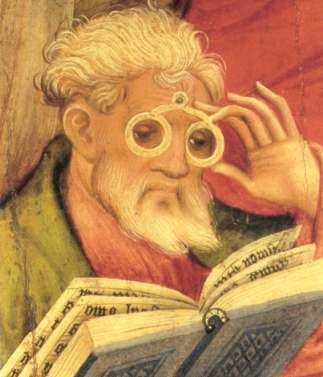
That secret is to allow the reader to see life through the 20/20 vision of the character’s eyes instead of the one-person-removed vision of the author. It’s all about showing, not telling. Showing is more difficult to do, but every time an author forsakes the showing approach for the easier and quicker I’ll-just-tell-you method, the reader is shortchanged and the story suffers.

Compare these two paragraphs: (Warning: neither one is great literature. I’m just trying to prove my point!)

1) A deep scum-covered pond lapped against the steps of the back porch. The whole house leaned toward the water as though it would someday sink beneath the dark surface. A tangle of willow trees grew at the edges of the pond, obscuring it from anyone on the road.

2) Devon stepped out on the back porch. His throat tightened. The whole backyard was a dark scum-covered pond. Water lapped against the porch steps, and Devon felt his feet slide against the rotting boards. He grabbed the porch rail. He couldn’t swim. If he fell in, he would never get out, and the tangle of willow that grew around the pond was so thick that no one on the road would ever see him.

Paragraph one doesn’t pull you in like paragraph two. Why? Paragraph one is description only. Paragraph two adds the sweet spice of emotion, because the reader is seeing the scene through the character’s eyes.

It’s hard for an author to admit, but characters are usually a lot more interesting than any author ever could be. When my readers pick up one of my novels about Alaska, 7000 B.C., they  don’t want to hear about it from someone who has never been there (like Sue Harrison). They want to hear about it from someone who is living there right now (like the woman Chagak in Mother Earth Father Sky).

I suggest that you practice the writing skill of showing-not-telling by looking through your own manuscript or through a book you are reading. When you find a paragraph of pure description (There are times when pure description is needed – a later post about that!) , rewrite it from a character’s up-close, 20/20, emotion-drenched point of view!

Have fun! Any questions?

Sue

*Writing the Third Dimension, copyright, 2010 Sue Harrison*

Sue HarrisonBestselling author, Sue Harrison, has written two Alaska trilogies: The Ivory Carver Trilogy and The Storyteller Trilogy, and a middle readers’ book SISU. Prior to the publication of her novels, Harrison was employed at Lake Superior State University as a writer and acting director of the Public Relations Department and as an adjunct instructor in creative writing and advanced creative writing. For more information, click here. To inquire about booking Sue for workshops or speaking engagements this year, click here.

Thanks for joining us! Please feel free to leave your questions and comments. We invite you come back July 25, 2013, for part 7.

Sue Harrison’s “Writing the Third Dimension” – part 5: CRASH! SMASH!

Welcome! Over the next many months we invite you to return here, specifically on the fourth Thursday of each month for the newest installment of Sue Harrison‘s teaching: Writing The Third Dimension. You can read all the segments by clicking on the page title WRITING THE THIRD DIMENSION, found under Writers’ Helps & Workshops on the drop-down menu. Please feel free to ask questions and leave comments for Sue. Now for the topic for month five:

******

“Writing the Third Dimension” – part 5: CRASH! SMASH!

When my oldest brother was in grade school, he discovered the delight of racing little plastic cars on a miniature track. He and my dad would each take a car and a controller and race and race and race. The winner was always elated, but I think they had the most fun when one of the cars would accidentally fly off the track, crash into the other car, and carry it off across the room, plastic parts flying.

If you are a writer, there’s a lesson to be learned in the art of crashing.  Novelists need to be experts at destruction, specifically, the destruction of their main character’s heart. We touched on this subject in my first Writing the Third Dimension post, but we need to dig a bit deeper into the process.

If you have a good understanding of your main character’s self-image issues (See Part 1 of Writing the Third Dimension: Heart Breaker), it’s time for you to take that wonderful person (or horrible person, if we’re talking about the villain)  and rip his or her world apart. You have to grab whatever that person loves most and smash it to smithereens. If you have a complex novel, with several main characters and a villain or two, you need to do that smashing stuff with every one of them.

Here are a few tips about smashing:

1. Your character’s central self-image can be smashed at any time in the novel, or even before the novel begins, but I’ve found the most effective smashing usually occurs within the first few chapters.

2. If you destroy your main character’s self-image BEFORE the novel begins, avoid the temptation to TELL the reader all about it in the first chapter. Or in the second chapter. Or ever in the novel. Feed it to your reader in small tasty bites. (We’ll discuss how to do this in a future post.)  Your reader wants to guess a bit about why the main character acts, talks, and defines the world as he does.

3. The most effective smashing occurs after the reader has bonded with the character.  Your reader will best bond through emotions.  In the first few chapters, the reader wants to know what your character loves, what your character enjoys, what your character hates. Let your reader see your character’s heart. Then SMASH! In my novel, Mother Earth Father Sky, I dedicated the first chapter to opening the main character’s world to the reader. It is a world foreign to most people because the novel takes place thousands of years ago in Alaska, but, by the end of the chapter, the reader knows that the main character, Chagak, is a young woman in love with the man who has just arranged to marry her. The reader learns that Chagak holds a place of respect in the village and is close to her parents and siblings. Then SMASH! Her whole world is destroyed by marauders, and she is the sole survivor.  Which brings us to point number 4.

4. Smashing hurts your heart. Be ready for that. If you don’t shed tears for your characters, your readers won’t shed tears either.

5. In longer, more complex novels, your main character may experience several SMASH situations in his or her life. A good example of this is the classic novel, Jane Eyre by Charlotte Bronte. Jane’s world crashes when, as a child, she must go live with her self-serving aunt and wicked cousins. It crashes again when she loses her best friend at boarding school, and it crashes yet again when she uncovers the great secret hidden by the love of her life.  Charlotte Bronte was a master at pulling her readers in by destroying her characters’ worlds.

Likewise, your novel will pull in your readers when you make judicious use of the art of crashing.

How do you feel about smashing? Are you good at destroying your characters’ worlds, or is that difficult for you?

Blessings and Happy Writing!

Sue

*Writing the Third Dimension, copyright, 2010 Sue Harrison*

Sue HarrisonBestselling author, Sue Harrison, has written two Alaska trilogies: The Ivory Carver Trilogy and The Storyteller Trilogy, and a middle readers’ book SISU. Prior to the publication of her novels, Harrison was employed at Lake Superior State University as a writer and acting director of the Public Relations Department and as an adjunct instructor in creative writing and advanced creative writing. For more information, click here. To inquire about booking Sue for workshops or speaking engagements this year, click here.

Thanks for joining us! Please feel free to leave your questions and comments. We invite you come back June 27, 2013 for part 6.

Sue Harrison’s “Writing the Third Dimension” – part 4: Fatal Flaw

Welcome! Over the next many months we invite you to return here, specifically on the fourth Thursday of each month for the newest installment of Sue Harrison‘s teaching: Writing The Third Dimension. You can read all the segments by clicking on the page title WRITING THE THIRD DIMENSION, found under Writers’ Helps & Workshops on the drop-down menu. Please feel free to ask questions and leave comments for Sue. Now for the topic for month four:

******

“Writing the Third Dimension” – part 4: Fatal Flaw

When I was in college, I overheard a young woman say to a friend, “Well, I can be friends with a girl who is smart, and I can be friends with a girl who is beautiful, but I just can’t stand a girl who’s beautiful and smart.”


That’s a very good summary of how your readers are going to feel about your main character if he or she is too perfect. We know our own vulnerabilities only too well. When we meet someone who is too talented, too beautiful, or too smart, all that perfection eats away at our self-esteem. So, unless you’re writing a spoof, please give your characters vulnerabilities. Your readers need to identify with the main character. Character flaws pull your reader into your novel, make that reader stick with you through 400 or more pages of story, and – best of all – inspire your readers to buy your next book. Perfection just doesn’t cut it!


If you’ve read any of the TWILIGHT series, you know that the main character Bella is a total klutz. She’s also not aware of her own beauty and not very popular. Those flaws help make Bella a very loveable character. I have to admit that nothing makes me ‘forgive’ a gorgeous Hollywood starlet more readily for her beauty than her sincere lament about her squinty eyes or crooked teeth.


Let’s face it. We all tend to romanticize life. In mid-winter we dream of life on the beach – warm sun, snacks and cold drinks in the cooler, family time… But in real life, beach days also include ants, sunburn, and sand – all over our hands, in our food, and in our bathing suits. Even the most romantic of readers want their novels to include a bit of sand in the beach scene and, more importantly, imperfection in their main characters.


DSCF3190


One caution – be careful with character flaws. Don’t make them so terrible that your reader turns away in disgust. For example, it’s probably not a good idea for your protagonist to be mean to children or dogs.


We all have character flaws. I, alas, like Bella, am a klutz. I also have a tendency to talk too much when I’m nervous. The main character in my current WIP (work in progress) is drop-dead gorgeous, except that her face is plastered with freckles. She’s also made some very unwise life choices. Are you working on a novel or short story? What’s your character’s flaw? Let’s share some ideas by composing a list.


What character flaws have you used within your writing, noticed in your reading, or put up with in real life?

Any questions for me?  Please feel free to ask!


Blessings and Happy Writing!


Sue


*Writing the Third Dimension, copyright, 2010 Sue Harrison*


Sue HarrisonBestselling author, Sue Harrison, has written two Alaska trilogies: The Ivory Carver Trilogy and The Storyteller Trilogy, and a middle readers’ book SISU. Prior to the publication of her novels, Harrison was employed at Lake Superior State University as a writer and acting director of the Public Relations Department and as an adjunct instructor in creative writing and advanced creative writing. For more information, click here. To inquire about booking Sue for workshops or speaking engagements this year, click here.

Thanks for joining us! Please feel free to leave your questions and comments. We invite you come back May 23, 2013, for part 5.

Feeling blue, & Emily Dickinson’s poem “I started early”

I lost last week.

Do you ever experience those segments of time when the hours seem to simply float on to nowhere leaving you behind, alone?

Do you ever feel that you cannot even get motivated enough to be progressive, or to even care whether you are or not?

Last week got away from me. I hate when that happens. Blue isn’t just a beautiful colour.

BLUE

The up side is Spring is taking hold here now. The birds are singing and building nests, some already feeding their young. Buds are beginning to swell, although at my home on a higher landscape the snow is not completely gone. This week is expected to be rainy some days, so that will take the last of the snow away. Good, I say!

Now to the main topic of my post … Emily Elizabeth Dickinson (December 10, 1830 – May 15, 1886)

She was a melancholy person and became very reclusive. Are you familiar with any of Emily Dickinson’s poetry? I didn’t know much about her or her writing, but awhile ago I came across one of her poems and I liked it so much I thought perhaps you would enjoy it on You Tube. Please take your time and watch it/listen to it several times to take it all in. Check it out: Emily Dickinson’s I started early    

Y0u can read about her life here. It’s a very interesting article.

I used to write a lot of poetry, but haven’t written much the last many years except in an online challenge. For me, poetry seems to tap into a part of my being that nothing else can reach, and releases from my inner thought processes what nothing else seems able to do.

blue sparkles

How do you feel about poetry? Do you enjoy it? 

Which do you prefer – reading it or writing it? or do you enjoy equally reading and writing poetry?

Thanks for reading, and … Creative Musings!  🙂

Sue Harrison’s “Writing the Third Dimension” – part 3: The Boyfriend List

Welcome! Over the next many months we invite you to return here, specifically on the fourth Thursday of each month for the newest installment of Sue Harrisons teaching: Writing The Third Dimension. You can read all the segments by clicking on the page title WRITING THE THIRD DIMENSION, found under Writers’ Helps & Workshops on the drop-down menu. Please feel free to ask questions and leave comments for Sue. Now for the topic for month three:

************

“Writing the Third Dimension” – part 3: The Boyfriend List

When I was twelve, I wrote a Boyfriend List. My list included all the dream qualities I considered ideal in a boyfriend. Most of it was very superficial: blue eyes, good athlete, smart, cute, and nice. Cute and nice? Ah well, I was only twelve.

Writing that list didn’t help me much during the angst years of junior high; however, it was the first indication that I would take after my maternal grandfather and become a list writer. I live on lists. Grocery lists, lists of goals, book idea lists, books I’ve read, housework to-do… I could go on, but I’ll spare you. If you are a list-maker, you’re going to like what I have to say next. If not, please give my suggestions at least a bit of consideration. I think they will be helpful for you as you write your novel.

You’ve been fostering a friendship with your main character. You’ve been carrying this brand new person in your head, having conversations with him, asking questions, getting to know her. That’s the creative Right Brain part. Now comes the Left Brain stuff. You need to write everything down. If you’re a “fly by the seat of your pants” kind of writer, you might resist doing that, but sometimes creativity has to bow to analysis. Your novel will have a much better chance to make it all the way to publication if you know your character so well that you convey his motivations and reactions so that they make sense to the reader throughout the novel. (And you also want the blue-eyed girl in the first chapter to still have blue eyes in the last chapter.) 

Most of you have done a character sketch, maybe when you were in junior high or high school. A character sketch? Yes, all this has been leading up to that old standard, the character sketch. (No histrionics, please!)

My usual character sketch includes these items: name, age, race, birth date, nationality, birthplace, hair color, eye color, skin color, facial characteristics, body type, unusual physical characteristics (tattoos, birthmarks, freckles and so on), weight, height, body language/mannerisms, voice, speech quirks (clichés, catch phrases), time period in which she/he lives, favorite food, favorite animal and television show and movie and book and music, favorite person, his/her parents, siblings, relatives, pets, jobs held, and schooling.

The list could be almost endless, and I’m sure that you’ll think of characteristics that I haven’t included. Your character sketch will vary, novel to novel. A character who lives in the 1800s will not have a favorite television show, of course, but he may have a favorite saddle. In my Alaska trilogies all characters have brown eyes and dark hair, so that was easy, but I needed to use other physical characteristics to help me – and my readers – differentiate one character from another. That was a little more complex.

You’ll need a sketch for each main character and probably for your primary villain. You may find yourself changing things in your character sketch as you progress through this novel, so an area for “additional notes” is a good idea. Don’t be afraid to throw in MORE than you probably need to know. Even though these facts may never come to light within the novel, the more you understand about your character, the better job you’ll do writing about him. Also, you never know when an unexpected twist may change the course of your novel. Characters do have a tendency to wrestle the keyboard away from the writer. That’s when I benefit from re-reading my character notes.

My character sketches get pretty messy by the end of my novel and often degenerate into layers of sticky-notes, but at least I have a reference to what I’ve done, changed, thought, and decided during the weeks and months of writing. 

What works best for me is to keep two ring binders for each novel I’m writing. One binder is for the chapters of my current draft. (You’ll need a four- or five-inch binder for this.) I use dividers between each chapter for easy reference. The other binder is for my research notes and also includes my character sketch notes and good stuff like the people to include in my author’s acknowledgements, reviewers who may want to read an ARC (advanced reader’s copy) of the novel, and maps. 

It comes down to this. You don’t need to keep all the little stuff in your head. Make lists, fill notebooks, write character sketches. That will leave room in your brain for the muse to stretch out and get comfortable!

(And as for me, it turns out that a writing a Boyfriend List was good preparation for creating novels. Who knew?)

My question for you: Are you a left-brained, analytic person or more of a seat-of-the-pants kind of writer? 

Any questions for me?

Happy Writing and Many Blessings!

Sue

*Writing the Third Dimension, copyright, 2010 Sue Harrison*

Sue HarrisonBestselling author, Sue Harrison, has written two Alaska trilogies: The Ivory Carver Trilogy and The Storyteller Trilogy, and a middle readers’ book SISU. Prior to the publication of her novels, Harrison was employed at Lake Superior State University as a writer and acting director of the Public Relations Department and as an adjunct instructor in creative writing and advanced creative writing. For more information, click here. To inquire about booking Sue for workshops or speaking engagements this year, click here.

Thanks for joining us! Please feel free to leave your questions and comments. We invite you come back April 25, 2013, for part 4.