Winning, writing and winter blahs

I’ve heard several people say February is such a long month that drags out Winter and feels so blah. Really?

February is the shortest month we have, and even though this is Leap Year with 29 days instead of 28, it’s still our shortest month.  We can do this! 

Here is what I did in anticipation of Spring and to help myself get through Winter:

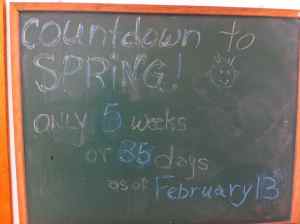
countdown to Spring


As you can see, that was February 13, so we’re closer now. Yay!  (I’ll soon set up a countdown timer on my blog, too.)

At the Alzheimer’s Caregivers Support Group meeting last week one of the men who attends brought roses for Valentine’s Day and gave them to all the ladies in attendance. Isn’t that sweet? The group is for family members who are caregivers of loved ones: a parent, a spouse, a friend. 

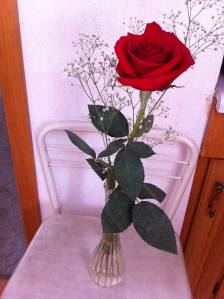
Here’s my rose:

Alz support group


Earlier that day I took Meyya to the groomer who is at the animal hospital/shelter in the veterinarian’s location in town. They were selling tickets on a basket of goodies. All I noticed was a teddy bear in there and I figured there was likely chocolate – which I can’t eat.  No matter, I bought a bunch of tickets because the money was to benefit the animal shelter. Well, on Friday didn’t they call to tell me I WON THE BASKET!!  Wowsers! 

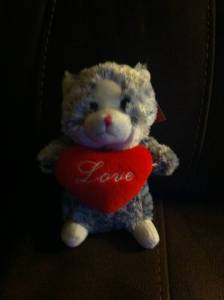
It turned out the teddy bear was this …

gift basket cat


cute, soft, little cat. 

In the basket with it: a gift certificate from a local diner, two bottles of wine, some healthy things from the healthfood store, and – yes, some chocolates. It was a lovely win and my husband received the chocolates. 🙂 

On another note: because of 12 x 12 in 2016 I am focusing more on my writing. I’ve completed the second revision of the story (picture book) I wrote in January, but I haven’t written a new story for this month. Even so, I’m so glad I signed on. I’ve benefited already. And my own private writing coach is super helpful and insightful. 

For me personally, February is a good month so far. I still have some things to take care of, which I plan to finalize this month, to free up a little more time and space for my writing. I’ll get there!

What are you doing to dismiss the winter blahs?

Thanks for reading, and … Creative Musings!  🙂


Baby steps toward CHANGE

2016, my year of change.

I’ve stated it publicly. I am determined to achieve it. I am committed to accepting it.  (Thanks, Darlene, for that last point.)

For me, change means stepping beyond myself, my comfort zone, my place of safety.  Even if that step is only a baby step, it is a step forward to my goal.

I am not saying I want to change everything about myself, or that I want to make drastic changes in my life. What I mean is I am working on my attitude and beliefs about my God-given abilities, talents, gifts, creativity. And fear – I am making baby steps away from the fear and toward the reality of who I am as a creative and what I am capable of doing.

“The key to change … is to let go of fear.”  – Rosanne Cash


My goal, which I’m sure you all know by now, is to write children’s books for publication. The changes have begun for me to achieve this:

  1. I have my own writing coach as of September 2015;
  2. I’m ending my publishing of a newsletter I (very sadly) haven’t had the focus and leading to do anymore; after many years it’s hard to let go. I have the final issue to complete and loose ends to tidy up;
  3. my publishing room will become my writing room, my creative space, which I’m excited to prepare;
  4. I’ve continued with Tara Lazar’s PiBoIdMo each November, keeping the ideas coming. To take those ideas further, Friday I signed on for a year of *12×12, making that huge (for me) leap in commitment when I’m not sure how I’m going to manage the challenge. Having said that, I signed on because I need what is being offered through it in order to reach my goal. (I did 12×12 in 2012, Julie Hedlund’s first year offering 12×12; now it’s much advanced from those beginnings.)

The biggest change for me is my private outlook, my self-talk, what I believe about myself. Change in those will bring about the most change in me and how I approach my writing.

“Incredible change happens in your life when you decide to take control of what you do have power over instead of craving control over what you don’t.” – Steve Maraboli

Yes, 2016 is my year of CHANGE, the follow-up to and continuation of POSITIVITY – my word in 2015.

I am determined.     I will need reminders. And energy. And focus and refocus. (That’s not a negative already, I know how it’s been and I’m needing to not go there.)

My life as caregiver will continue as it has been, with the change being in me, in how I use my other time. There’s no progress in wishing things were different.

“Life has no remote. Get up and change it yourself.” – Thegoodvibe.co

This could be an exciting year, a challenging year, a surprising year.

2016.

My year of change.

* If YOU are interested in writing children’s books, it is not too late to sign up for 12×12. Just follow the link I provided above in my point #4.

Can you relate to the struggle of staying the course? What are your goals and determinations that you know will make a remarkable change for you? (Or put that in past tense, what were your goals … and how did you manage to meet them?)

Thanks for reading, and … Creative Musings!  🙂

2015 in review

I didn’t think I did much blogging this year because I know my posts were fewer, however, according to WordPress it seems as if I’ve been quite busy here. I do enjoy blogging, so it’s rewarding to read a report like this one. If you’re interested in reading the whole thing you can follow the link included below.

Here is my 2015 blog report:

The WordPress.com stats helper monkeys prepared a 2015 annual report for this blog.

Here’s an excerpt:

A New York City subway train holds 1,200 people. This blog was viewed about 7,900 times in 2015. If it were a NYC subway train, it would take about 7 trips to carry that many people.

Click here to see the complete report.

Do you have any thoughts to share about Polilla Writes?

Thanks for reading, and … Creative Musings!  🙂

Sue Harrison’s “Writing the Third Dimension”, part 35: Fare Thee Well

Welcome back for the final installment of Sue Harrison’s writers’ workshop: Writing The Third Dimension. We invite you to return here anytime to read and learn from the fabulous thirty-five segments from January 2013-December 2015.  (There was no post for WTTD in December 2013.) Simply click on the page title WRITING THE THIRD DIMENSION, found under Writers’ Quotes, Helps & Workshops on my drop-down menu. Please feel free to ask questions and leave comments for Sue. I’ll be sure to let her know when you do so she can reply. We both love hearing from you.

Now for the topic for month thirty-five:

*****

“Writing the Third Dimension” – part 35: Fare Thee Well

When I began writing these posts for Polilla Writes, I thought I would have enough material for about a year, maybe a year and a half. It turns out that I’m much more verbose than I ever dreamed! However, the time has come for me to conclude the “Writing The Third Dimension” series. What a joyous privilege has been mine to write these posts, get to know all of you, and to learn so much from all of you!

This is not good-bye. I’ll be back, commenting on the wonderful posts Lynn, “Polilla,” shares with us all, and from time to time, I’ll drop in with a post about books — mine and those of others.

In this, my closing segment, I thought perhaps you might like to read the second chapter of the novel I’ve been writing during the time I was also writing for Polilla Writes. Sharing stories is one of the great joys of my life. So here’s another story, at least the beginning of a story. I hope you enjoy it!

[Note from Lynn: Please note, the shared segment is COPYRIGHTED, no copying by any method allowed. Thank you.]

IMG_2172

BONE FIRE, A Novel of Ancient Europe

*******

Chapter Two

Awna the Woman

The-Month-of-Dying-Sun

(November)

5814 B.C.


The earth was frozen less than a hand-length down, so Awna needed only half a morning to chop away the soil and the tree roots to carve out the old man’s grave.

Under the oak trees that spread their autumn-broken leaves against the sky, she used the wide, flat blade of her digging stone to pry up pads of moss. Webbed with the night’s meager snowfall, the moss carried the heavy scent of rich, wet earth, a smell the old man had loved, so Awna layered it as a bed at the bottom of his grave. The size of an eight-winter child, that old man, smaller even than Awna, but she was strong from the years she had spent as his slave, carrying his packs. She easily pulled his body to the hole, her fingers cupped gently over his brittle bones. She lowered him in, feet first, and, when he was lying in the grave, she crouched on the edge as if she might slide down and claim space for herself.

“So Rolf, finally I am free. You could have waited until spring. It would have been easier.”

At least he had died quickly, his hands suddenly fisted against his chest, his teeth clenched, his breath pulsing out in one long hiss. She should not have told him. What was there about that crooked old man that so easily coaxed out the truth even when it was best forgotten?

Sunlight, shredded by the canopy of oaks, cast splintered shadows over Rolf’s pile of trade goods. Perhaps all those things were hers now, being who she was. Perhaps they were not, considering what she had done.

She did not care much about the shell necklaces, the birdbone needles, the small flint darts, the arrowheads, not even the oval bracelets cut in one piece from pearled edges of sea-clam shells. The bags of dried and pounded pot clay? She could dig up more.

Most of all, she wanted his thick fox-pelt blanket. Once, in the summer, when some bird spit a fever into Awna’s head, Rolf had wrapped her in that blanket, and the cool, soft fur chased out her blighted dreams, lured her back into the real and living world.

So what could she take and what should she bury? Would the old man come back to curse her if she did not give him enough?  He needed gifts for his ancestors.

Of course, she would not bury the hand-sized flakes of salt sewn into their deerskin packets. If she buried the salt, the earth would leech it away from Rolf’s grave. Perhaps then it would poison the guarding oaks. Why put herself into the middle of that fierce battle?

Always, always, though, that salt had been dearer to him than Awna could ever be, except during the one moment which had killed him.

She gave first what was easiest to give, the flute Rolf had made from the hollow wing bone of a vulture. Rolf had drilled five finger holes into the vulture bone and given it a strange fishlike mouth – pike, not carp — that somehow caught his breath and turned it into the low trembling melodies that only Rolf knew how to make.

She lay flat on her belly at one side of the grave and leaned down, slid that flute into his clutched hands. Some contrary part of her spirit wished for one more night song, firelight dancing. That wish made her eyes burn, so she stood and shook herself loose of the memories. Then she untied her grass cloak, swung it away from her shoulders. She had cut the grass for the cloak and dried it, then stitched it length over length until it hung long enough to reach her ankles. It shed water far better than fox fur ever could. She dropped the cloak into the grave, watched it settle in stiff folds over his beautiful fine-boned face, over his thin crooked legs and large clever hands.

“For you, Rolf, a trade.”

Awna held his fox-pelt blanket close to her mouth, blew into the fur to make it hers. Then, except for the salt, she divided all things between them, gave him half the blades, half the dried meat, half the smoked fish, half the beads and bracelets, half the pot clay, even half of her furred suslik skins, although she herself had caught those tricky ground squirrels, and she herself scraped away the flesh, stretched the small pelts on greenstick hoops, and knuckled soft fat into each flensed side.

When Rolf’s share lay with him in the grave, Awna pushed the forest’s thick, dark dirt over top until the hole was full. She layered leaf mold over the dirt then searched out what stones she could find, those rocks carried high into the forest by the Mother River, one year or another, as that river bucked herself free of winter ice. Awna piled the rocks over the grave so no digging animal could get to the old man.

She brushed the soil from her deerskin tunic and from her leggings. She licked the dirt’s dark stain from the palms of her hands. Would the old man follow her, his spirit given breath by longing? She had buried him so far from his home, traveling as they had been on their last trade journey before winter. Surely he would be restless, even under the comfort of the oaks. She cupped her hands over her belly. Would he try to take her baby now living there?

As small as the cap of an acorn, that baby, as the stem of a cap.

Perhaps Léleks would try to steal it, since she had lost the old man’s protection. Those deadly Léleks, twisted spirits, offspring of lost curses.

The wind sent its edged breath deep into her lungs, making her cough. Winter. Too close.

Always, since her mother sold her, Awna had only followed. How does a follower learn to walk her own path?

She leaned close to the grave, spoke loudly so Rolf could hear her through the stone and earth. “So what should we do, this baby and me? We cannot live outside in winter. Would you let me return to your house and use it as my own?”

A long journey that would be, but better than spending winter’s hard, cold days alone in an oak forest.

As if Rolf had traveled back to answer her, underbrush snapped and voices came from just beyond the stand of oaks. Awna crouched low and small, raked her fingers through her hair until the dark curls fell forward to cover her face. Her breath squeezed in so shallow that her acorn-baby lifted a thin cry of protest from her belly. But as she peeked through her hair, she saw those noisy ones walk into the oak clearing and realized they were just ordinary men.

Dark of hair and eyes they were, as are all people. Two carried a dead boar, hung by its legs from a sapling they balanced on their shoulders, an old boar, blood dripping black from age-stained tusks. The third man, although muscled thick in his arms and shoulders, carried nothing but throwing-spears, cradling them as if he were a woman holding a baby.

The three men stopped and stared at Awna, and the one holding the spears opened his mouth, ready to speak, but said nothing. His hair and beard had grown into a tumble of ringlets; his eyes were large and his ears. He shifted his gaze to the packs jumbled in a heap against the nearest oak. Then he pointed at the grave and asked, “A child?”

Awna pushed her hair back from her face and stood up. “No. He was old.” Why tell them more than that?

The spear-carrier turned and spoke to the others, and he spoke with such a wide swinging rhythm that Awna’s ears were not quick enough to catch all his words. Dried blood marked the men’s faces as if they had used it for paint, and their wide belts bristled with flint-blade knives.

So what was best, she asked herself, to pretend she had people waiting for her? Or should she try to find a place with these three men?

She did not want them to think the old man’s packs were theirs to take, so she walked to the pile and slung the largest on her back. The smaller ones she tied to her belt, and she hung the packets of salt from her shoulders. Slow she was, doing all this, but the men stood and watched. She tied the fox-pelt blanket around her waist. When she had taken all there was to take, she stared down at Rolf’s grave, wondering if she would hear his high, thin voice scolding her for greed, but he said nothing.

Awna pulled in a breath and was sure she could smell the moss of his sunken bed. So how terrible would it be if she and her acorn-baby were killed and left in this good place? They would be safe from winter. Everyone knew the dead did not feel the cold.

She pulled a small chert blade from her belt and cut a few stitches at the top edge of a greased packet, lifted it so the men could see the hand-size flake of salt inside. Then she waited for them to kill her, salt being more precious than any woman’s life could ever be.

The one who carried the spears stepped close and pinched the edge of the salt. He licked his fingers and looked at the other two men, shifting foot to foot under the weight of the dead boar. The salt-taster laughed, a low troubled sound, as if suddenly he had something to worry about.

“Where are you going?” he asked Awna, his words slow enough that she understood.

She pointed east and then south.

He said: “My village is close.”

Of course, their village was close. Men did not carry a dead boar, dripping blood, any great distance. Wolves, dogs, soft-pawed mountain lions would catch the scent. In near-winter, those animals would be glad for the meat, even of an old bitter-flesh boar.

“My village is not close,” she said, trying to match the rhythm of his words. She was a fool to admit she had no protection near, but her back ached and her arms, and she had blistered her hands digging that grave. Inside, she felt so empty that she wondered if her soul had stayed down there with Rolf. Why not give the salt-taster greater reason to kill her? Better to have the pain over soon than waste more time listening to his high-singing words.

Awna breathed in one last smell of moss and earth and oak. She would be a part of it whether these three buried her or simply left her body for whatever animal found it first.  Be strong, she told her acorn-baby, and she tilted back her head, so the man could see the long vein at the side of her neck. “Quickly,” she told him.

He set the butts of the spears on the ground, braced them in the crook of his left arm. He ran his thumb down the length of her pulsing vein, and Awna pulled her thoughts into that warm, dark world where her acorn-baby lived.

The man caught a handful of her hair and tugged gently until she lifted her head to look into his eyes. His voice was little more than a whisper when he said, “My name is Cob. I need a wife.”

copyright, 2015, Sue Harrison

*******

 So this is not Good-Bye, only Fare Thee Well, and Thank You

More than Words can ever Say.

Merry Christmas, Happy New Year, Happy Hanukkah!

Strength to your pen!

Sue
*Writing the Third Dimension, copyright, 2010 Sue Harrison*

Sue HarrisonBestselling author, Sue Harrison, has written two bestselling Alaska trilogies: The Ivory Carver Trilogy and The Storyteller Trilogy – all of which went digital in May 2013. She also wrote a middle readers’ book SISU. Prior to the publication of her novels, Harrison was employed at Lake Superior State University as a writer and acting director of the Public Relations Department and as an adjunct instructor in creative writing and advanced creative writing. For more information, click here. To inquire about booking Sue for workshops or speaking engagements this year, click here.

Thanks for joining us! Please feel free to leave your questions and comments. Sue has generously shared her knowledge and expertise with us for free all these months. This has been a tremendous gift, one for which I am very grateful. If you want to let Sue know what this has meant to you, if her teaching has benefited you in any way, I’m sure she would be thrilled to hear about it.

Thank you, Sue, so very much. I look forward to receiving posts from you when you have something to share with us. 


PiBoIdMo — I won the challenge!

It’s December 1 already –

twenty-four days to Christmas.

December 1 –

the day after PiBoIdMo ended, and …

the first day of Post-PiBo.

Post-PiBo is the week after the inspirational Picture Book Idea Month (brain child of Tara Lazar), the week when daily guests post encouraging and helpful advice on how to proceed with all our ideas gleaned in thirty days.

Yesterday, November 30, was the last day of the 30-day challenge to write a picture book idea each day – any idea that could be used in creating a picture book. This was my fifth year of taking on PiBoIdMo and it is my most creative to date. I’ve completed (won) in the other four years I’ve done this, but this year? This year I surprised myself. On day 17 I already had 30 ideas! By the end of day 30, the final day of the challenge, I completed with 65 – yes! 65! – ideas. 

Here’s my badge to prove it.

piboidmo2015winner

Yessiree … I’m doing my happy dance! 

the-seinfeld-happy-dance

Not quite like that but you get my point.

Actually, if when even one of my ideas is developed into a picture book and makes it to being published, the above will be even less of the happy dance I’ll be doing. You can be sure of that.  🙂  Perhaps you will join me? 

One year I won one of the prizes given out at the end. It was a cute caricature of me, based on the illustrator’s insect characters. I may show you sometime what he sent me. I think it’s meant to be a combination of a firefly and a mosquito – or a misinterpretation of a firefly.

Tara Lazar does an amazing job of putting together six weeks of inspiration for writers of all skill levels and experience. She is a published picture book author herself, having written The Monstore which I reviewed hereLittle Red Gliding Hood, I Thought This Was a Bear Book, and Normal Norman.  She has two more picture books coming out in 2016. I urge you to buy, borrow, and for sure .. read and share .. her books.

Right now I am happy and feeling a little proud of myself for managing to go beyond what I’ve done before. This time I will complete manuscripts.

What or who inspires you? What challenges helped you to go beyond what you thought you could do?

Thanks for reading, and … Creative Musings! 🙂

Sue Harrison’s “Writing the Third Dimension”, part 34: A Fairy Tale for Writers

Welcome back! For the rest of this year we invite you to return here, specifically on the fourth Thursday of each month for the newest installment of Sue Harrison’s teaching: Writing The Third Dimension. You can read and learn from all the fabulous segments from 2013-2015 by clicking on the page title WRITING THE THIRD DIMENSION, found under Writers’ Helps & Workshops on my drop-down menu. Please feel free to ask questions and leave comments for Sue. Now for the topic for month thirty-four:

*****

“Writing the Third Dimension” – part 34: A Fairy Tale for Writers

Once upon a time in a deep dark woods, lived a girl named Write-arella. More than anything in the world, Write-arella wanted to write novels, but publishers told her that her books were too long, or they were too short. They were too silly, or they were too serious. And by the way, why was every book set in a deep dark woods?

File:CinderAdelphi.jpg

Finally after writing and writing and writing some more, Write-arella finished a book that publishers liked, and they published it. Then Write-arella and her handsome prince lived happily ever, eating chocolate-covered strawberries and going on book tours.

The End

Yeah right. The truth is…

The deep dark woods are real. The book tours are real, and sometimes even the chocolate-covered strawberries are real. Write-arella did marry a prince of a guy, but he told her that if she really wanted success as an author, she couldn’t just sit around eating chocolate-covered strawberries and watching football games. (Actually, the Prince was the one who watched the football games.)

The prince said Write-arella needed to do more than write a book and get it published. She had to work for her success.

So after Write-arella’s book was published, she begged libraries, churches, and schools for speaking opportunities. She asked friends and family members to set up book signings in their local bookstores. She judged chili contests, hawked books at boat shows, and attended blueberry festivals. She spoke at writers’ conferences.  She gave commencement addresses at high schools and colleges.  She dropped in for reading week at local elementary schools.

The Prince decided they should also travel all over the country and visit every little bookstore they could find.  At each store, they introduced themselves, talked to the manager, signed stock, chatted with customers, and then went on to the next town and the next bookstore.

After they arrived back home at the castle, Write-arella mailed notes to the bookstores they’d visited and added them to her Christmas card list.

She and the Prince bought copies of her books from her publishers, and they sold them at craft fairs and community gatherings and at local gas stations and restaurants and curio stores. She started her own blog and her own Facebook page. She met a wonderful writer who allowed Write-arella to post how-to columns on the writer’s blog, Polilla Writes.

And every day — or almost every day — Write-arella wrote.

The moral of the story? A writer’s work is not finished just because the book is. If you self-publish or if you sign a contract with a publisher, you need to be ready to celebrate – not only with chocolate-covered strawberries, but also with a lot of hard (and fun!) work.

What out-of-the-box ideas do you use (or plan to use) to sell your books?  What out-of-the-box ideas have enticed you to buy a book?

Strength to your Pen!

Sue

*Writing the Third Dimension, copyright, 2010 Sue Harrison*

Sue HarrisonBestselling author, Sue Harrison, has written two bestselling Alaska trilogies: The Ivory Carver Trilogy and The Storyteller Trilogy – all of which went digital in May 2013. She also wrote a middle readers’ book SISU. Prior to the publication of her novels, Harrison was employed at Lake Superior State University as a writer and acting director of the Public Relations Department and as an adjunct instructor in creative writing and advanced creative writing. For more information, click here. To inquire about booking Sue for workshops or speaking engagements this year, click here.

Thanks for joining us! Please feel free to leave your questions and comments. We invite you to come back December 24, 2015, for part 35, which is the FINAL installment of this fabulous series.


Sue Harrison’s “Writing the Third Dimension”, part 33: Alternatives

Welcome back! For the rest of this year we invite you to return here, specifically on the fourth Thursday of each month for the newest installment of Sue Harrison’s teaching: Writing The Third Dimension. You can read and learn from all the fabulous segments from 2013-2015 by clicking on the page title WRITING THE THIRD DIMENSION, found under Writers’ Helps & Workshops on my drop-down menu. Please feel free to ask questions and leave comments for Sue. Now for the topic for month thirty-three:

*****

“Writing the Third Dimension” – part 33: Alternatives

When I began writing Mother Earth Father Sky way back in the 1970s, options for publication were pretty much the following. You could submit your novel directly to a small publisher or university press. You could find an agent who would begin the submission process to larger publishing houses. You could pay big bucks to a vanity press to publish the book. You could self-publish, which would still cost thousands and pretty much relegate your novel to the dreaded “ignored” category. Ignored by bookstores, ignored by reviewers, ignored by readers.

Today, with the advent of ebooks and print-on-demand, self-publishing carries no loss of prestige, and it doesn’t break the author’s budget.

I’m not an expert at self-publishing because I haven’t  gone that route yet. I believe someday I will, but right now I have too many projects on my desk to pursue that possibility. So this post is not about those steps of pursuit. You can find many self-publishing experts on line. I recommend literary agent Rachelle Gardner’s book, which will walk you through the decision process. How Do I Decide? Self-Publishing vs Traditional Publishing (A Field Guide for Authors) is available as an ebook through Amazon for $2.99. Definitely worth the price!

Rachelle-Ebook-02-Self-vs-Forest-Green-White-Lettering-Small

Meanwhile, let’s talk about the positives and negatives of self-publishing.

Positive aspects:

1. You are in control. You decide what gets edited out of your novel and what you want to leave in. You control cover art. You control font choices. You control length.

2. You decide what time of year to publish your book. If you want to bring it out in time for Christmas, you can. If you want to arrange publication according to your personal schedule,  you can. You’re not in lockstep with the publishers’ other books, waiting your turn.

3. You can keep your novel in print as long as you want. Publishers usually “retire” in-print novels, many times it’s after only a few months on bookstore shelves.

4. Once you pay the costs, you don’t have to split the profits with a publisher.

Of course, there are negative aspects:

1. You pay. If your novel comes out as an ebook, you might pay between $100 and $300 to have your manuscript formatted. Hard copy books are of course more expensive, but print-on-demand allows those costs to come to the author in a more gradual way. You may decide to hire an editor to vet your work before you publish it. Editing costs can range from several hundred to several thousand dollars, but the choice is up to you. I do recommend an editor, not only for grammar, spelling, and typos, but for content. You want your novel to be the best possible. Otherwise, you may lose your readership for a second book.

2. You must find your own cover art and pay the artist.

3. You may have to acquire more “techie” skills to ready your manuscript for ebook formatting.

4. You must do your own PR work. In the current publishing climate, that’s also true with many commercial publishers. So this isn’t as much of a deterrent as it used to be. Still, you can’t sit back and expect someone else to research the market for you or find bookstores willing to carry your novel.

5. Most national reviewers don’t review self-published novels. On the local scene, though, many reviewers do. It’s your job to find them.

The most important thing for a writer with a completed first novel to know is that self-publishing exists as a viable option. You do not ruin your career if you decide to self-publish. You’re simply getting your novel out there to an audience.

Have you considered or pursued self-publishing? Tell us your experience!

Strength to your pen!

Sue

*Writing the Third Dimension, copyright, 2010 Sue Harrison*

Sue HarrisonBestselling author, Sue Harrison, has written two bestselling Alaska trilogies: The Ivory Carver Trilogy and The Storyteller Trilogy – all of which went digital in May 2013. She also wrote a middle readers’ book SISU. Prior to the publication of her novels, Harrison was employed at Lake Superior State University as a writer and acting director of the Public Relations Department and as an adjunct instructor in creative writing and advanced creative writing. For more information, click here. To inquire about booking Sue for workshops or speaking engagements this year, click here.

Thanks for joining us! Please feel free to leave your questions and comments. We invite you to come back November 26, 2015, for part 34.