Sue Harrison’s “Writing the Third Dimension” – part 10: The Writer as Actor

Welcome! Over the next many months we invite you to return here, specifically on the fourth Thursday of each month for the newest installment of Sue Harrison‘s teaching: Writing The Third Dimension. You can read all the segments by clicking on the page title WRITING THE THIRD DIMENSION, found under Writers’ Helps & Workshops on the drop-down menu. Please feel free to ask questions and leave comments for Sue. Now for the topic for month ten:

******

“Writing the Third Dimension” – part 10: The Writer as Actor

In my first three Alaska novels, my characters do not sit on chairs. They don’t even sit cross-legged on the ground; they squat on their haunches. This is a very typical pose for people who live without furniture, but the problem is, other than on a few camping trips, I’ve lived with furniture all my life. So to write about my ancient Aleut people, I had to learn how to sit on my haunches. It wasn’t easy, but, by learning, I avoided having my characters do something that would not work physically.  In effect, I became an actor and acted out the “sitting on haunches” portions of the novel. Since then, when I’m writing a scene, I often get up from my chair and act it out right in my office. It’s amazing how much more convincing and realistic your words will be if you back your scenes with a healthy dose of “acting out.”

Janet_Marie_Chvatal_'Sissi'

Here are a few acting tips that might help you as you write your novel:

1. If you are writing fight scenes and have no experience in that particular arena of life, take a self-defense class. It sure helped me write more realistic and gritty fight scenes.

2. Don’t be afraid to take up a new hobby. If your main character sews quilts, buy a book, take a class, do a little quilting.

3. Use your mirror. Imagine yourself angry and look at your face in the mirror. What are you doing with your eyes? Your mouth? Your eyebrows? Don’t get overly descriptive. A word or two will do.

4. Enlist your DVD player. Watch a good movie and check out how the actors express their emotions. Replay scenes that catch your heart and keep a pad handy to jot down the first words that come to mind as you watch the actors laugh, cry, express anger, fear, dread, etc.

5. Watch babies and young children. They haven’t yet learned to guard their feelings by masking facial expressions. They are the exaggerated versions of adult facial behavior.

6. Read articles or even a book about body language.  My husband, a high school principal, had a training session in how to tell if people are lying. He shared the information with me, and since then it’s appeared in subtle ways in my short stories and my novels.  The Internet abounds with resources. Take an hour or so  and have fun learning how people express emotions with body language.

7. Pay attention to hands and feet. A person might have a good poker face, but his/her hands and fingers, feet and toes are “saying” what s/he really feels.

The next time you sit down to write, remember, you’re not only a writer; you’re an actor. Stride boldly onto the stage and become your characters!

Have fun! Any questions?

Sue

*Writing the Third Dimension, copyright, 2010 Sue Harrison*

Sue HarrisonBestselling author, Sue Harrison, has written two Alaska trilogies: The Ivory Carver Trilogy and The Storyteller Trilogy, and a middle readers’ book SISU. Prior to the publication of her novels, Harrison was employed at Lake Superior State University as a writer and acting director of the Public Relations Department and as an adjunct instructor in creative writing and advanced creative writing. For more information, click here. To inquire about booking Sue for workshops or speaking engagements this year, click here.

Thanks for joining us! Please feel free to leave your questions and comments. We invite you to come back November 28, 2013, for part 11.

The Case for Good Taste in Children’s Books – (reprinted by permission)

It has been very hard for me to “buckle down” and “just write”, likely because I feel used up in one way or another almost every day. I’m trying to get back into blogging more because I enjoy it and because I hope I’m posting things of help to you, my readers.

The following article is long but one worth sharing, and I’m doing so with permission. You can check out the publication in which it’s printed: here.

PLEASE NOTE: THIS ARTICLE IS NOT INTENDED FOR YOUNG READERS BECAUSE OF SOME OF ITS CONTENT.

The Case for Good Taste in Children’s Books MEGHAN COX GURDON has been the children’s book reviewer for the Wall Street Journal since 2005. Her work has also appeared in numerous other publications, including the Washington Post, the Washington Examiner, the San Francisco Chronicle, National Review, and the Weekly Standard. In the 1990s, she worked as an overseas correspondent in Hong Kong, Tokyo, and London, and traveled and reported from Cambodia, Somalia, China, Israel, South Korea, and Northern Ireland. She graduated magna cum laude from Bowdoin College in 1986 and lives near Washington, D.C., with her husband and their five children.The following is adapted from a speech delivered at Hillsdale College on March 12, 2013, sponsored by the College’s Dow Journalism Program.ON JUNE 4, 2011, the number one trending topic on Twitter was the Anthony Weiner scandal. I happen to remember that, because the number two topic on Twitter that day—almost as frenzied, though a lot less humorous—had to do with an outrageous, intolerable attack on Young Adult literature . . . by me. Entitled “Darkness Too Visible,” my article discussed the increasingly dark current that runs through books classified as YA, for Young Adult—books aimed at readers between 12 and 18 years of age—a subset that has, in the four decades since Young Adult became a distinct category in fiction, become increasingly lurid, grotesque, profane, sexual, and ugly.Books show us the world, and in that sense, too many books for adolescents act like funhouse mirrors, reflecting hideously distorted portrayals of life. Those of us who have grown up understand that the teen years can be fraught and turbulent—and for some kids, very unhappy—but at the same time we know that in the arc of human life, these years are brief. Today, too many novels for teenagers are long on the turbulence and short on a sense of perspective. Nor does it help that the narrative style that dominates Young Adult books is the first person present tense—“I, I, I,” and “now, now, now.” Writers use this device to create a feeling of urgency, to show solidarity with the reader and to make the reader feel that he or she is occupying the persona of the narrator. The trouble is that the first person present tense also erects a kind of verbal prison, keeping young readers in the turmoil of the moment just as their hormones tend to do. This narrative style reinforces the blinkers teenagers often seem to be wearing, rather than drawing them out and into the open.

Bringing Judgment

The late critic Hilton Kramer was seated once at a dinner next to film director Woody Allen. Allen asked him if he felt embarrassed when he met people socially whom he’d savaged in print. “No,” Kramer said, “they’re the ones who made the bad art. I just described it.” As the story goes, Allen fell gloomily silent, having once made a film that had received the Kramer treatment.

I don’t presume to have a nose as sensitive as Hilton Kramer’s—but I do know that criticism is pointless if it’s only boosterism. To evaluate anything, including children’s books, is to engage the faculty of judgment, which requires that great bugbear of the politically correct, “discrimination.” Thus, in responding to my article, YA book writers Judy Blume and Libba Bray charged that I was giving comfort to book-banners, and Publisher’s Weekly warned of a “danger” that my arguments “encourage a culture of fear around YA literature.” But I do not, in fact, wish to ban any books or frighten any authors. What I do wish is that people in the book business would exercise better taste; that adult authors would not simply validate every spasm of the teen experience; and that our culture was not marching toward ever-greater explicitness in depictions of sex and violence.

Books for children and teenagers are written, packaged, and sold by adults. It follows from this that the emotional depictions they contain come to young people with a kind of adult imprimatur. As a school librarian in Idaho wrote to her colleagues in my defense: “You are naïve if you think young people can read a dark and violent book that sits on the library shelves and not believe that that behavior must be condoned by the adults in their school lives.”

What kind of books are we talking about? Let me give you three examples—but with a warning that some of what you’re about to hear is not appropriate for younger listeners.

A teenaged boy is kidnapped, drugged, and nearly raped by a male captor. After escaping, he comes across a pair of weird glasses that transport him to a world of almost impossible cruelty. Moments later, he finds himself facing a wall of horrors, “covered with impaled heads and other dripping, black-rot body parts: hands, hearts, feet, ears, penises. Where the f— was this?”

That’s from Andrew Smith’s 2010 Young Adult novel, The Marbury Lens.

A girl struggles with self-hatred and self-injury. She cuts herself with razors secretly, but her secret gets out when she’s the victim of a sadistic sexual prank. Kids at school jeer at her, calling her “cutterslut.” In response, “she had sliced her arms to ribbons, but the badness remained, staining her insides like cancer. She had gouged her belly until it was a mess of meat and blood, but she still couldn’t breathe.”

That’s from Jackie Morse Kessler’s 2011 Young Adult novel, Rage.

I won’t read you the most offensive excerpts from my third example, which consist of explicit and obscene descriptions by a 17-year-old female narrator of sexual petting, of oral sex, and of rushing to a bathroom to defecate following a breakup. Yet School Library Journal praised Daria Snadowsky’s 2008 Young Adult novel, Anatomy of a Boyfriend, for dealing “in modern terms with the real issues of discovering sex for the first time.” And Random House, its publisher, gushed about the narrator’s “heartbreakingly honest voice” as she recounts the “exquisite ups and dramatic downs of teenage love and heartbreak.”

The book industry, broadly speaking, says: Kids have a right to read whatever they want. And if you follow the argument through it becomes: Adults should not discriminate between good and bad books or stand as gatekeepers, deciding what young people should read. In other words, the faculty of judgment and taste that we apply in every other area of life involving children should somehow vaporize when it comes in contact with the printed word.

I appeared on National Public Radio to discuss these issues with the Young Adult book author Lauren Myracle, who has been hailed as a person “on the front lines in the fight for freedom of expression”—as if any controversy over whether a book is appropriate for children turns on the question of the author’s freedom to express herself. Myracle made clear that she doesn’t believe there should be any line between adult literature and literature for young people. In saying this, she was echoing the view that prevails in many progressive, secular circles—that young people should encounter material that jolts them out of their comfort zone; that the world is a tough place; and that there’s no point shielding children from reality. I took the less progressive, less secular view that parents should take a more interventionist approach, steering their children away from books about sex and horror and degradation, and towards books that make aesthetic and moral claims.

Now, although it may seem that our culture is split between Left and Right on the question of permissiveness regarding children’s reading material, in fact there is not so much division on the core issue as might appear. Secular progressives, despite their reaction to my article, have their own list of books they think young people shouldn’t read—for instance, books they claim are tinged with racism or jingoism or that depict traditional gender roles. Regarding the latter, you would not believe the extent to which children’s picture books today go out of the way to show father in an apron and mother tinkering with machinery. It’s pretty funny. But my larger point here is that the self-proclaimed anti-book-banners on the Left agree that books influence children and prefer some books to others.

Indeed, in the early years of the Cold War, many left-wing creative people in America gravitated toward children’s literature. Philip Nel, a professor at Kansas State University, has written that Red-hunters, “seeing children’s books as a field dominated by women . . . deemed it less important and so did not watch it closely.” Among the authors I am referring to are Theodor Geisel (Dr. Seuss) and Ruth Krauss, author of the 1952 classic A Hole is to Dig, illustrated by a young Maurice Sendak. Krauss was quite open in her belief that children’s literature was an excellent means of putting left-wing ideas into young minds. Or so she hoped.

When I was a little girl I read The Cat in the Hat, and I took from it an understanding of the sanctity of private property—it outraged me when the Cat and Thing One and Thing Two rampaged through the children’s house while their mother was away. Dr. Seuss was probably not intending to inculcate capitalist ideas—quite the contrary. But it happened in my case, and the point is instructive.

Taste and Beauty

A recent study conducted at Virginia Tech found that college women who read “chick lit”—light novels that deal with the angst of being a modern woman—reported feeling more insecure about themselves and their bodies after reading novels in which the heroines feel insecure about themselves and their bodies. Similarly, federal researchers were puzzled for years by a seeming paradox when it came to educating children about the dangers of drugs and tobacco. There seemed to be a correlation between anti-drug and anti-tobacco programs in elementary and middle schools and subsequent drug and tobacco use at those schools. It turned out that at the same time children were learning that drugs and tobacco were bad, they were taking in the meta-message that adults expected them to use drugs and tobacco.

This is why good taste matters so much when it comes to books for children and young adults. Books tell children what to expect, what life is, what culture is, how we are expected to behave—what the spectrum is. Books don’t just cater to tastes. They form tastes. They create norms—and as the examples above show, the norms young people take away are not necessarily the norms adults intend. This is why I am skeptical of the social utility of so-called “problem novels”—books that have a troubled main character, such as a girl with a father who started raping her when she was a toddler and anonymously provides her with knives when she is a teenager hoping that she will cut herself to death. (This scenario is from Cheryl Rainfield’s 2010 Young Adult novel, Scars, which School Library Journal hailed as “one heck of a good book.”) The argument in favor of such books is that they validate the real and terrible experiences of teenagers who have been abused, addicted, or raped—among other things. The problem is that the very act of detailing these pathologies, not just in one book but in many, normalizes them. And teenagers are all about identifying norms and adhering to them.

In journalist Emily Bazelon’s recent book about bullying, she describes how schools are using a method called “social norming” to discourage drinking and driving. “The idea,” she writes, “is that students often overestimate how much other kids drink and drive, and when they find out that it’s less prevalent than they think—outlier behavior rather than the norm—they’re less likely to do it themselves.” The same goes for bullying: “When kids understand that cruelty isn’t the norm,” Bazelon says, “they’re less likely to be cruel themselves.”

Now isn’t that interesting?

Ok, you say, but books for kids have always been dark. What about Hansel and Gretel? What about the scene in Beowulf where the monster sneaks into the Danish camp and starts eating people?

Beowulf is admittedly gruesome in parts—and fairy tales are often scary. Yet we approach them at a kind of arm’s length, almost as allegory. In the case of Beowulf, furthermore, children reading it—or having it read to them—are absorbing the rhythms of one of mankind’s great heroic epics, one that explicitly reminds us that our talents come from God and that we act under God’s eye and guidance. Even with the gore, Beowulf won’t make a child callous. It will help to civilize him.

English philosopher Roger Scruton has written at length about what he calls the modern “flight from beauty,” which he sees in every aspect of our contemporary culture. “It is not merely,” he writes, “that artists, directors, musicians and others connected with the arts”—here we might include authors of Young Adult literature—“are in a flight from beauty . . . . There is a desire to spoil beauty . . . . For beauty makes a claim on us; it is a call to renounce our narcisissm and look with reverence on the world.”

We can go to the Palazzo Borghese in Rome and stand before Caravaggio’s painting of David with the head of Goliath, and though we are looking at horror we are not seeing ugliness. The light that plays across David’s face and chest, and that slants across Goliath’s half-open eyes and mouth, transforms the scene into something beautiful. The problem with the darker offerings in Young Adult literature is that they lack this transforming and uplifting quality. They take difficult subjects and wallow in them in a gluttonous way; they show an orgiastic lack of restraint that is the mark of bad taste.

Young Adult book author Sherman Alexie wrote a rebuttal to my article entitled, “Why the Best Kids Books are Written in Blood.” In it, he asks how I could honestly believe that a sexually explicit Young Adult novel might traumatize a teenaged mother. “Does she believe that a YA novel about murder and rape will somehow shock a teenager whose life has been damaged by murder and rape? Does she believe a dystopian novel will frighten a kid who already lives in hell?”

Well of course I don’t. But I also don’t believe that the vast majority of 12-to-18-year-olds are living in hell. And as for those who are, does it really serve them to give them more torment and sulphur in the stories they read?

The body of children’s literature is a little like the Library of Babel in the Jorge Luis Borges story—shelf after shelf of books, many almost gibberish, but a rare few filled with wisdom and beauty and answers to important questions. These are the books that have lasted because generation after generation has seen in them something transcendent, and has passed them on. Maria Tatar, who teaches children’s literature at Harvard, describes books like The Chronicles of Narnia, The Wind in the Willows, The Jungle Books, and Pinocchio as “setting minds into motion, renewing senses, and almost rewiring brains.”

Or as William Wordsworth wrote: “What we have loved/others will love, and we will teach them how.”

* * *

The good news is that just like the lousy books of the past, the lousy books of the present will blow away like chaff. The bad news is that they will leave their mark. As in so many aspects of culture, the damage they do can’t easily be measured. It is more a thing to be felt—a coarseness, an emptiness, a sorrow.

“Beauty is vanishing from our world because we live as if it does not matter.” That’s Roger Scruton again. But he doesn’t want us to despair. He also writes:

It is one mark of rational beings that they do not live only—or even at all—in the present. They have the freedom to despise the world that surrounds them and live another way. The art, literature, and music of our civilization remind them of this, and also point to the path that lies always before them: the path out of desecration towards the sacred and the sacrificial.

Let me close with Saint Paul the Apostle in Philippians 4:8:

Whatever is true, whatever is noble, whatever is right, whatever is pure, whatever is lovely, whatever is admirable—if anything is excellent or praiseworthy—think about such things.

And let us think about these words when we go shopping for books for our children.


Copyright © 2013 Hillsdale College. Permission to reprint in whole or in part is hereby granted, provided the following credit line is used: “Reprinted by permission from Imprimis, a publication of Hillsdale College.” 

****

Any comments? I’m interested in knowing your thoughts on this topic.

Thanks for reading, and … Creative Musings! 🙂

Sue Harrison’s “Writing the Third Dimension” – part 9: Sing out!

Welcome! Over the next many months we invite you to return here, specifically on the fourth Thursday of each month for the newest installment of Sue Harrison‘s teaching: Writing The Third Dimension. You can read all the segments by clicking on the page title WRITING THE THIRD DIMENSION, found under Writers’ Helps & Workshops on the drop-down menu. Please feel free to ask questions and leave comments for Sue. Now for the topic for month nine:

******

“Writing the Third Dimension” – part 9: Sing Out!

Few things convey a writer’s skill more dramatically than Voice.  For something that is so important, Voice is difficult to define, but let me give it a try.  (You knew I would, right?) Voice is the “person” you hear talking in your head as you read a book.  I know that sounds rather strange, but that’s what Voice is to me – the narrator/storyteller/magic genie/ Pooh Bear/ crocodile who speaks to me from the pages. (Crocodile? Sorry. This was the best photo of a mouth that I could find…)

Gators_mouth

When a reader begins reading your novel, or agents or editors are taking that first look at your unpublished manuscript, a strong Voice will keep them reading past the first paragraph.

Here are a few quotes from authors who are gifted with strong Voices:

1.  “When Mary Lennox was sent to Misselthwaite Manor to live with her uncle everybody said she was the most disagreeable-looking child ever seen.” Frances Hodgson Burnett, The Secret Garden. (A tongue-in-cheek sentence that foreshadows both the serious and the humorous sides of this classic children’s book. The lack of a comma after the word uncle carries a subtle message that this book and its characters don’t always obey the rules.)

2.   “Awake! For Morning in the Bowl of Night Has flung the Stone that puts the Stars to Flight: And Lo! the Hunter of the East has caught The Sultan’s Turret in a Noose of Light.” The Rubaiyat of Omar Khayyam, translated by Edward Fitzgerald. (The meter and rhymes support the exotic, visual, and poetic nature of this work.)

3.  “Marley was dead, to begin with.  There is no doubt whatever about that.  The register of his burial was signed by the clergyman, the clerk, the undertaker, and the chief mourner.”  A Christmas Carol by Charles Dickens. (Short to-the-point sentences and short phrases separated by commas tell the reader that the life portrayed in this novel is harsh, and that the writer is an honest man about to relate important facts and truths of life.)

So, how do we get there (writing with a strong Voice) from here (no Voice yet established)?

First, and most importantly, we need to decide what aura we hope to convey. Let’s consider the possibilities. Where is the novel set?  What type of speech will that location suggest to our readers? Do we want our readers to hear an accent in the narrator’s words?  Is the theme of the novel something soft or harsh? What is the genre? (Genres generally have a general type of voice. Detective novels often use a quick, to-the-point voice. Romances may have more flowery and flowing voices. However, exceptions sometimes make a novel noteworthy.)

Second, we should search out published books with a similar theme or setting or in the same genre. Then the fun part: read, read, read. Their words in our heads combined with our natural writing “personality” will help us choose the best devices to use as we develop our novel’s Voice.

Here’s a list of devices.  Long phrases or short phrases.  Lots of commas or a dearth of commas.  Long and short sentences and combinations thereof.  Alliteration of words; the rhythm of our sentences; creative punctuation. Fancy words, short words, old-fashioned sounding words, modern words, made-up words.  Short or long paragraphs. Following all the rules of grammar religiously, or breaking a few rules here and there. Contractions (casual) or no contractions (formal). I’m sure you can think of more.

With my first novel Mother Earth Father Sky, I spent a month working on the Voice and used my studies of Native American languages to help me establish a general rhythm (short, short, long — a poet would say “anapestic”) that follows Native speech patterns.

Then I wrote one page. I rewrote it until I liked it, and then I read that page out loud.  And rewrote again. And read it out loud again. For days, I worked on that one page until I knew that my narrator was “speaking” my novel with a distinct Voice that conveyed my theme, my setting, and my point-of-view characters’ mindsets. Then I printed out that page and kept it handy. Each time I sat down to write, I skimmed the page and settled that Voice back into my head. That’s what worked for me. Maybe it will work for you!

Any questions or comments? How do you develop a Voice for your work?

Sue

*Writing the Third Dimension, copyright, 2010 Sue Harrison*

Sue HarrisonBestselling author, Sue Harrison, has written two Alaska trilogies: The Ivory Carver Trilogy and The Storyteller Trilogy, and a middle readers’ book SISU. Prior to the publication of her novels, Harrison was employed at Lake Superior State University as a writer and acting director of the Public Relations Department and as an adjunct instructor in creative writing and advanced creative writing. For more information, click here. To inquire about booking Sue for workshops or speaking engagements this year, click here.

Thanks for joining us! Please feel free to leave your questions and comments. We invite you come back October 24, 2013, for part 10.

Sue Harrison’s “Writing the Third Dimension” – part 8: Patchwork

Welcome! Over the next many months we invite you to return here, specifically on the fourth Thursday of each month for the newest installment of Sue Harrison‘s teaching: Writing The Third Dimension. You can read all the segments by clicking on the page title WRITING THE THIRD DIMENSION, found under Writers’ Helps & Workshops on the drop-down menu. Please feel free to ask questions and leave comments for Sue. Now for the topic for month eight:

******

“Writing the Third Dimension” – part 8: Patchwork

When I was about seven years old, my Grandma Kate made me a quilt for my doll. Exquisitely pieced with tiny hand stitches, that quilt is one of my most precious possessions. Each square is about one inch by one inch, and scattered throughout are squares that are plain red, but the other squares are from my grandmother’s dresses, and my grandfather’s shirts and pajamas. The variety is lovely, and the red squares, although scattered without a fixed design, unite the others into a cohesive whole. As I write this, the quilt lies in the center of my dining room table, background for a lovely piece of Belgian lace and an old-fashioned-looking oil lamp. I smile each time I look at the table. What a treasure my grandmother gave to me.

P7010047

Writers also need to use patchwork as they compose their novels. Last month in my Writing the Third Dimension blog post, I explained how important it is to allow readers to “see” most description through the characters’ eyes, rather than as a narration from the writer’s point-of-view. I did mention that there were exceptions, and that’s what we’ll discuss today – exceptions. Legitimate reasons exist for brief patchwork bits of narration that don’t come directly from a character’s viewpoint. Here are the most common:

1. At the beginning of a novel before a character is introduced. It’s very tempting to write a page or two or three, but this type of narration should be limited to a sentence or two or three. Otherwise, your reader is going to get bored and stop reading before getting into the real story.

2. To allow a reader to catch his or her breath in a very intense, suspenseful scene. A sentence is usually enough to do the trick and give a pacing pause that actually increases the suspense for most readers.

3. When the reader needs a quick “you are here” logistical placement.

4. If you are using multiple points-of-view within your novel, and you are moving the narrative out of one character’s head, or point-of-view, into another’s. Without that bit of even ground between, it’s uncomfortable and confusing for the reader.

5. If there is some information that your point-of-view character does not know (a bit of history or even something that will happen in the future), but that will enrich your reader’s experience. This is tricky and shouldn’t happen often within a novel, if at all. Again use that one- to three-sentence limit to keep your reader in the story.

6. The information you are presenting doesn’t merit more than a sentence.

Novelists will find themselves confronted with nearly all of these situations in each book they write. They’re the ‘patchwork’ stuff, but as the writer you don’t want them to sound patchy. You want them to blend in, and the best way to do that is the same way a good quilter sews a quilt – with tiny inconspicuous stitches.

Okay, I can hear your question right now. What does that mean within the context of a novel?

1. Don’t get out your thesaurus. Use normal everyday words.

2. Make your point and then jump into a character’s point-of-view or a dialog.

3. Avoid complex sentences.

There you have it. A reason to break the rules and how to do so inconspicuously. Maybe it’s time to add here that one of the biggest mistakes new novelists make is adhering too rigidly to the rules, and someday we’ll talk about that, too!

My question for you: When you give someone directions or describe something, do you tend to be long-winded or to-the-point?

Sue

*Writing the Third Dimension, copyright, 2010 Sue Harrison*

Sue HarrisonBestselling author, Sue Harrison, has written two Alaska trilogies: The Ivory Carver Trilogy and The Storyteller Trilogy, and a middle readers’ book SISU. Prior to the publication of her novels, Harrison was employed at Lake Superior State University as a writer and acting director of the Public Relations Department and as an adjunct instructor in creative writing and advanced creative writing. For more information, click here. To inquire about booking Sue for workshops or speaking engagements this year, click here.
Thanks for joining us! Please feel free to leave your questions and comments. We invite you come back September 26, 2013 for part 9.

Sue Harrison’s “Writing the Third Dimension” – part 7: I or He or is it Me?

Welcome! Over the next many months we invite you to return here, specifically on the fourth Thursday of each month for the newest installment of Sue Harrison‘s teaching: Writing The Third Dimension. You can read all the segments by clicking on the page title WRITING THE THIRD DIMENSION, found under Writers’ Helps & Workshops on the drop-down menu. Please feel free to ask questions and leave comments for Sue. Now for the topic for month seven:

******

“Writing the Third Dimension” – part 7: I or He or is it Me?

Decisions, decisions…

When you are writing a novel,  decisions are part of the process. One of the most important decisions you as a novelist have to make is how to present your main character(s) to your readers. That presentation is commonly known as point-of-view. You will see point-of-view abbreviated in many writers’ blogs and how-to books as pov.

With pov you have two basic choices – first person point-of-view and third person point-of-view.

I went for a walk, and I met my enemy. First person pov

He went for a walk, and he met his enemy. Third person pov

Now you can get a little fancy or funky and use second person, but second person (You go for a walk and you meet your enemy.) is generally used within the context of a first person point-of-view presentation or, on occasion, to convey the thoughts of a character being presented in the third-person-point-of-view. So we’ll delegate a discussion of second person point-of-view to  another time and another place.

To make your pov decision, you need to know what each pov offers to your novel, because they both have strengths and weaknesses. Let’s talk about some of those.

First Person Point-of-View Strengths:

  • First person generally pulls the reader into the protagonist’s mind more quickly, so the reader identifies more easily with the main character.
  • First person is often best for readers who prefer their novels to follow only one main character.
  • First person is usually (not always) the POV of choice for literary novels because stream-of-consciousness and an unusual “voice” (My next “Writing the Third Dimension” will be about voice.) are often very important to literary novels, and for most novelists stream-of-consciousness and an unusual voice are more easily achieved through first person pov presentations.
  • First person is often used for mysteries in which the novelist wants both the reader and the protagonist to be struggling to figure out who-dun-it.
  • Novelists who write in the young adult genre often use first person pov because a certain percentage of their readers are not reading by choice. They are reading by assignment, and thus they are more antagonistic to characters and plot. A first person presentation, with its limited pov and strong emotional pull, captures them more easily.

Third Person Point-of-View Strengths:

  • In multi-character novels with a wide historical or geographic scope, third person pov makes for an easier presentation of extensive ideas and a wide variety of cultures and characters.
  • With third person pov, the reader feels more distance between himself/herself and the characters, which means the writer can more readily present some of the action through the eyes and mind of a villain without grossing out a sensitive reader. This is a who-is-your-audience situation and will depend on your novel’s genre. In the horror genre, writers don’t hesitate to convey a villain’s thoughts from a first person pov. In an inspirational genre, that might not work so well.
  • In some suspense and mystery novels, the writer wants the reader to know what is going on while the protagonist remains clueless. In third person pov, secondary characters can provide information through conversations or thoughts that are presented to the reader but not to  the protagonist.

First Person Point-of-View Weaknesses:

  • Some readers refuse to read books written in first person pov. This is a personal preference, but I’ve yet to find a reader who refuses to read a book written in third person pov.
  • The writer can’t suddenly hop into another character’s mind in first person pov. If the character telling the story doesn’t know some fact, that character can’t suddenly present that fact to the reader. Now I know there are successful exceptions to this rule, but 98% of the time, in first person pov, if the main character doesn’t know something then it can’t be presented to the reader.
  • In first person pov, it’s very easy to fall into “telling” the story rather than “showing” what’s going on. If this concept is confusing to you, please refer to my last “Writing the Third Dimension” post (June 2013)  entitled “20/20.”

Third Person Point-of-View Weaknesses:

  • In third person pov, it sometimes takes a reader longer to feel an emotional bond with the main characters.
  • Novels written in third person are often more complex in plot, which for some readers is a disadvantage.

When I’m deciding which point-of-view to use in a short story or a novel, I sometimes write the first chapter both ways. Then I can tell which one flows better, and I make my decision according to that.

Point-of-view is a complex topic, so, if I’ve managed to do nothing more than confuse you, please feel free to ask questions. Otherwise, as a reader, do you have a preference – first person point-of-view or third person point-of-view?

Sue

*Writing the Third Dimension, copyright, 2010 Sue Harrison*

Sue HarrisonBestselling author, Sue Harrison, has written two Alaska trilogies: The Ivory Carver Trilogy and The Storyteller Trilogy, and a middle readers’ book SISU. Prior to the publication of her novels, Harrison was employed at Lake Superior State University as a writer and acting director of the Public Relations Department and as an adjunct instructor in creative writing and advanced creative writing. For more information, click here. To inquire about booking Sue for workshops or speaking engagements this year, click here.

Thanks for joining us! Please feel free to leave your questions and comments. We invite you come back August 22, 2013, for part 8.

Sue Harrison’s “Writing the Third Dimension” – part 6: 20/20 vision

Welcome! Over the next many months we invite you to return here, specifically on the fourth Thursday of each month for the newest installment of Sue Harrison‘s teaching: Writing The Third Dimension. You can read all the segments by clicking on the page title WRITING THE THIRD DIMENSION, found under Writers’ Helps & Workshops on the drop-down menu. Please feel free to ask questions and leave comments for Sue. Now for the topic for month six:

******

“Writing the Third Dimension” – part 6: 20/20

This post is one of the most important in our series, “Writing The Third Dimension,” so “listen up” (as one of my favorite teachers used to say.)  Employing the following technique can turn an ordinary novel into that book you just can’t put down.

For years this technique was a secret owned by only the most elite bestselling novelists, but then somebody normal – like you and me – figured it out, and now we can all use it to our advantage. Hooray!

File:Conrad von Soest, 'Brillenapostel' (1403).jpg

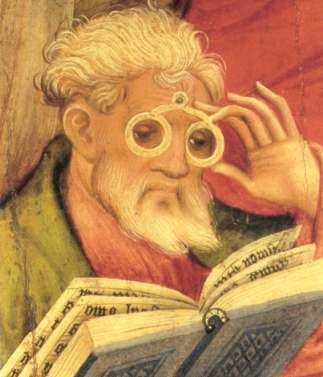
That secret is to allow the reader to see life through the 20/20 vision of the character’s eyes instead of the one-person-removed vision of the author. It’s all about showing, not telling. Showing is more difficult to do, but every time an author forsakes the showing approach for the easier and quicker I’ll-just-tell-you method, the reader is shortchanged and the story suffers.

Compare these two paragraphs: (Warning: neither one is great literature. I’m just trying to prove my point!)

1) A deep scum-covered pond lapped against the steps of the back porch. The whole house leaned toward the water as though it would someday sink beneath the dark surface. A tangle of willow trees grew at the edges of the pond, obscuring it from anyone on the road.

2) Devon stepped out on the back porch. His throat tightened. The whole backyard was a dark scum-covered pond. Water lapped against the porch steps, and Devon felt his feet slide against the rotting boards. He grabbed the porch rail. He couldn’t swim. If he fell in, he would never get out, and the tangle of willow that grew around the pond was so thick that no one on the road would ever see him.

Paragraph one doesn’t pull you in like paragraph two. Why? Paragraph one is description only. Paragraph two adds the sweet spice of emotion, because the reader is seeing the scene through the character’s eyes.

It’s hard for an author to admit, but characters are usually a lot more interesting than any author ever could be. When my readers pick up one of my novels about Alaska, 7000 B.C., they  don’t want to hear about it from someone who has never been there (like Sue Harrison). They want to hear about it from someone who is living there right now (like the woman Chagak in Mother Earth Father Sky).

I suggest that you practice the writing skill of showing-not-telling by looking through your own manuscript or through a book you are reading. When you find a paragraph of pure description (There are times when pure description is needed – a later post about that!) , rewrite it from a character’s up-close, 20/20, emotion-drenched point of view!

Have fun! Any questions?

Sue

*Writing the Third Dimension, copyright, 2010 Sue Harrison*

Sue HarrisonBestselling author, Sue Harrison, has written two Alaska trilogies: The Ivory Carver Trilogy and The Storyteller Trilogy, and a middle readers’ book SISU. Prior to the publication of her novels, Harrison was employed at Lake Superior State University as a writer and acting director of the Public Relations Department and as an adjunct instructor in creative writing and advanced creative writing. For more information, click here. To inquire about booking Sue for workshops or speaking engagements this year, click here.

Thanks for joining us! Please feel free to leave your questions and comments. We invite you come back July 25, 2013, for part 7.

Sue Harrison’s “Writing the Third Dimension” – part 5: CRASH! SMASH!

Welcome! Over the next many months we invite you to return here, specifically on the fourth Thursday of each month for the newest installment of Sue Harrison‘s teaching: Writing The Third Dimension. You can read all the segments by clicking on the page title WRITING THE THIRD DIMENSION, found under Writers’ Helps & Workshops on the drop-down menu. Please feel free to ask questions and leave comments for Sue. Now for the topic for month five:

******

“Writing the Third Dimension” – part 5: CRASH! SMASH!

When my oldest brother was in grade school, he discovered the delight of racing little plastic cars on a miniature track. He and my dad would each take a car and a controller and race and race and race. The winner was always elated, but I think they had the most fun when one of the cars would accidentally fly off the track, crash into the other car, and carry it off across the room, plastic parts flying.

If you are a writer, there’s a lesson to be learned in the art of crashing.  Novelists need to be experts at destruction, specifically, the destruction of their main character’s heart. We touched on this subject in my first Writing the Third Dimension post, but we need to dig a bit deeper into the process.

If you have a good understanding of your main character’s self-image issues (See Part 1 of Writing the Third Dimension: Heart Breaker), it’s time for you to take that wonderful person (or horrible person, if we’re talking about the villain)  and rip his or her world apart. You have to grab whatever that person loves most and smash it to smithereens. If you have a complex novel, with several main characters and a villain or two, you need to do that smashing stuff with every one of them.

Here are a few tips about smashing:

1. Your character’s central self-image can be smashed at any time in the novel, or even before the novel begins, but I’ve found the most effective smashing usually occurs within the first few chapters.

2. If you destroy your main character’s self-image BEFORE the novel begins, avoid the temptation to TELL the reader all about it in the first chapter. Or in the second chapter. Or ever in the novel. Feed it to your reader in small tasty bites. (We’ll discuss how to do this in a future post.)  Your reader wants to guess a bit about why the main character acts, talks, and defines the world as he does.

3. The most effective smashing occurs after the reader has bonded with the character.  Your reader will best bond through emotions.  In the first few chapters, the reader wants to know what your character loves, what your character enjoys, what your character hates. Let your reader see your character’s heart. Then SMASH! In my novel, Mother Earth Father Sky, I dedicated the first chapter to opening the main character’s world to the reader. It is a world foreign to most people because the novel takes place thousands of years ago in Alaska, but, by the end of the chapter, the reader knows that the main character, Chagak, is a young woman in love with the man who has just arranged to marry her. The reader learns that Chagak holds a place of respect in the village and is close to her parents and siblings. Then SMASH! Her whole world is destroyed by marauders, and she is the sole survivor.  Which brings us to point number 4.

4. Smashing hurts your heart. Be ready for that. If you don’t shed tears for your characters, your readers won’t shed tears either.

5. In longer, more complex novels, your main character may experience several SMASH situations in his or her life. A good example of this is the classic novel, Jane Eyre by Charlotte Bronte. Jane’s world crashes when, as a child, she must go live with her self-serving aunt and wicked cousins. It crashes again when she loses her best friend at boarding school, and it crashes yet again when she uncovers the great secret hidden by the love of her life.  Charlotte Bronte was a master at pulling her readers in by destroying her characters’ worlds.

Likewise, your novel will pull in your readers when you make judicious use of the art of crashing.

How do you feel about smashing? Are you good at destroying your characters’ worlds, or is that difficult for you?

Blessings and Happy Writing!

Sue

*Writing the Third Dimension, copyright, 2010 Sue Harrison*

Sue HarrisonBestselling author, Sue Harrison, has written two Alaska trilogies: The Ivory Carver Trilogy and The Storyteller Trilogy, and a middle readers’ book SISU. Prior to the publication of her novels, Harrison was employed at Lake Superior State University as a writer and acting director of the Public Relations Department and as an adjunct instructor in creative writing and advanced creative writing. For more information, click here. To inquire about booking Sue for workshops or speaking engagements this year, click here.

Thanks for joining us! Please feel free to leave your questions and comments. We invite you come back June 27, 2013 for part 6.